What are the advantages of EDO DIMM? Why is Intel server SC450NX designed for buffered 3.3V EDO DIMM instead of SDRAM?
SDRAM is an improvement over EDO in that it synchronizes the DRAM operation between the clock of the chipset controller and the CPU clock. However, this benefit has often been overrated, and the saving due to synchronization is only on the order of 1 to 5%, all other things being kept equal. Other memory considerations can easily outweigh this small advantage. As an example, large server memories, such as the 4GB maximum of the SC450NX, require much greater system reliability than standard PC systems.
The design and qualification of the DRAM must conform to stringent guidelines for background radiation tolerance to prevent grossly unacceptable soft error rates in such a large system. When the engineering team selects a memory type for a high-end server, they may not be able to choose the latest technology if that technology has not proven itself with regard to acceptable soft error rates. I am not privy to the SC450NX design considerations, but I expect that well established soft error rates for the chip types available at design inception were one of the more serious considerations for their choice.
What is the difference between unbuffered, buffered and registered DIMMs?
A buffer is used with EDO memory, and a register is used with SDRAM memory. They both work similarly to achieve the same function, but a register uses a synchronous SDRAM clock to lock in the signals, and a buffer simply buffers the EDO signals, as EDO memory has no synchronizing clock.
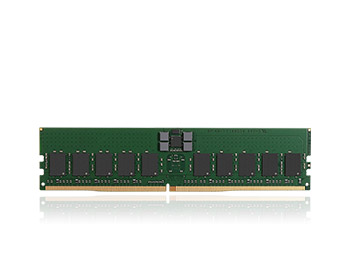
Most SDRAM and EDO DIMMs sold today are the unbuffered variety. When four or more heavily loaded, high-density DIMMs are used in a system memory, registers or buffers are added to each DIMM module to reduce the address and control signal load. Registers and buffers present a small load to the memory controller on the motherboard, yet each buffer or register may drive many chips (loads) on a DIMM module. DIMM modules can have as many as 36 memory chips on them, such as in stacked chip configurations used in very high-density memory.
A large buffered EDO server system can contain 16 DIMM modules and support 4GB of system memory with great reliability. The necessary downside is that a buffer will add about 5nanoseconds to the system timing budget, and a register will add one CAS latency. A current rule of thumb: if your entire memory system load is near or exceeds 64 chips (4 DIMM modules x 18 chips/module = 72 chips) you will almost certainly need registered SDRAM or buffered EDO memory modules. Your system may run with 4 fully loaded unbuffered DIMMs, but it will likely have little or no noise margin left. Some systems won’t even boot with a total of 64 chips installed on 4 unbuffered DIMMs.
What is ECC?
ECC stands for Error Correction Code that can correct a bad bit in main system memory.
Unlike the older parity bit, which would tell you if a bit was bad or not, ECC will correct 1 bit out of 64, and detect but not correct 2 bits bad out of 64 bits (64 bits is the standard DIMM data bus width today).
In an ECC memory bus there will be 8 bits of ECC information along with 64 bits of data for a total memory bus width of 72 bits. That is why ECC memory typically has a “72” somewhere in the module configuration part number, and non-ECC typically has a “64”.
Why does one need ECC, especially if most memory shipped in home PCs today has
There are three somewhat interrelated reasons:
1. Cosmic rays can cause soft errors in DRAM memory, and can change a 1 bit to a 0 bit (never the reverse). The memory is not damaged, and that bit can be later written with a 1 and the memory will work fine just as before. That is not to say that a seriously powerful cosmic ray couldn’t permanently damage memory, but that would be a very, very rare event at sea level. But how rare is this normal soft error type of event? Much effort over the years has been devoted to measuring and reducing the effect of cosmic rays on system memory. As a result, some very rough guidelines can be given for the sea level error rate in a 128MB DIMM module, and that can be about 13 soft errors per year, or about one per month. Note that this rate is very dependent on how the memory is designed, and could easily be four times better than what IBM observed with some 4 MBits Japanese EDO memory in one of their carefully done experiments involving millions of device hours of testing. Suppose, assuming a conservative estimate of cosmic ray induced soft events alone, your system with 128MB of memory crashed or suffered serious corruption about four times a year, would that be acceptable? I suspect you now have a feeling for why ECC is so important.
2. PC systems are using more memory nowadays, and soft error rates scale linearly with the amount of installed memory, all other things being kept equal. Systems with 32MB are being replaced with 64MB and 128MB, and soon 256MB systems will be common. Servers easily range from 1GB to 4GB of installed memory, and the uncorrected soft error rates for these larger systems are universally regarded as intolerable.
3. The die sizes for memory are shrinking, and it is easier for a puny cosmic ray to cause a memory bit to flip to zero. In fact, as memory sizes continue to shrink, there is an increasing probability that not one bit, but a cluster of bits will flip to zero. ECC will do a wonderful job of correcting a single bad bit, but in the future a more advanced form of ECC, which IBM calls chipkill correct, will be required to correct an entire memory chip that goes bad. IBM’s Netfinity servers have chipkill correct, and all high-end servers and critical application systems require better correction than ECC. The good news is that normal PC systems will do just fine with ECC, and it may be a few years before more advanced correction will be needed here.
What is the difference between 16MX8 chips and 16MX4 chips in a 256MB memory
Memory modules can be made from a variety of different chips, but not all possibilities are permissible. A 256MB ECC DIMM memory module can be made with 18 16Mx8 chips or 36 16Mx4 chips. But it could also be made with 18 32Mx4 chips, 9 32Mx8 chips or 5 32Mx16 chips.
(For a more complete understanding of what and why, please refer to the reference "Understanding DIMM Module Configurations, with Contemporary Examples.”)
What is the difference between different CAS Latencies, for example, between CL2 and CL3?
A read from memory involves a row address strobe (RAS) followed by a column address strobe (CAS). The term CL refers to Column address strobe Latency (note that there is no difference in write performance for CL2 or CL3 memory). In a CL3 memory the read data is available 3 clock cycles after the CAS. In a CL2 memory the data is available 1 clock earlier, in only 2 clock cycles.
In typical systems in mid 1999, a CL2 PC100 memory will show around a 1 to 4% improvement in system performance over a CL3 memory. With even faster CPU speeds, or specialized graphic intensive applications, CL2 performance improvements can exceed 4%. One can have CL4 memory, and with the forthcoming DDR memory, one can even have CL2.5 and CL3.5.
What is the relationship between the CPU, chipset, bus, and memory?
A contemporary CPU does not talk directly to the main system DRAM memory, but through one or more intermediaries. One reason for the complexity is that as CPU speeds increase they are waiting longer and longer periods for the slow DRAM memory to respond. A second reason is that fast memory (the kind that fast CPUs would prefer) is very expensive compared to DRAM.
Typically the CPU will talk first to L1 cache that is a small amount of very specialized static RAM memory running at the same speed as the processor. The L1 cache memory typically talks to a larger amount of specialized L2 cache static memory residing on or near the CPU, and under the direction of an onboard L2 cache controller. L2 cache is physically located on the chip in the new Celerons of Intel, or next to the CPU on what is called the backside bus for the slot 1 and slot 2 Intel cards, or on a bit of nearby motherboard real estate in older Pentium and 486 systems. The L2 cache then talks with the main DRAM memory through the intermediary of the “North Bridge” chip of the motherboard chipset. The CPU to L2 cache backside bus typically runs at half the CPU speed, but occasionally as fast as the CPU as in the case of the Celerons.
The CPU to motherboard North Bridge chipset bus is called the Front Side Bus (FSB), and typically runs at 100MHz, although 133MHz is in the works, and 66MHz was the old, prior standard. The North Bridge chipset bus to the main DRAM memory is called the memory bus, and typically runs at 66MHz to 100MHz, and 133MHz (expected in September 1999).
If you think this arrangement is complex, you're right, but it is likely to get more complex in the future. An L3 cache between main DRAM memory and L2 cache is being considered for some of the newer systems. Note also the trend is to put more and more functions into the main CPU chip. I expect soon to see the DRAM memory controller, currently located in the North Bridge chip, to be integrated into the CPU silicon for a substantial increase in memory performance.
Why do gold and tin contacts make a difference? Isn't gold better?
Whenever dissimilar metals are placed in contact with each other, galvanic action can and usually does take place. You can think of a gold to tin contact as a very tiny, very low power battery. With time, crud can form in the gold to tin interconnection, very much like the crud you will find on ordinary batter terminals that are several years old. If the contact degradation becomes bad enough, you will have an intermittent or dead memory system. The solution is to use gold with gold, and tin with tin. One connector manufacturer claimed that in some rare situations tin to tin is best, but any contact expert knows that properly done gold to gold is by far the best, long term, low voltage connection.
What kind of memory do Intel servers take? For example, the Intel SC450NX- does it
Yes, and that is because this powerful memory system is 4-way interleaved for increased throughput. Note that many low end to medium servers of Intel (for example, MS440GX, T440BX, N440BX, L440GX and C440GX) are just like ordinary PC systems in that you can install a single DIMM and they will work fine.
What is SPD?
SPD (Serial Presence Detect) is physically a tiny non-volatile memory chip on a memory module that can be read by the memory controller on the motherboard, and contains the critical parameter information for that module. This information includes memory type, size, speed, voltage interface, number of row addresses, column addresses, module banks, and other critical parameters. This data is used by the system BIOS to correctly configure the memory system.
A memory controller can be very sophisticated in probing what is on each memory module during boot time, but when an SPD is not used on the module, the memory controller must make assumptions about many critical timings. Unfortunately, the memory controller must be very conservative about such guesses, or the system might become unreliable, or in worse case it could hang forever during the boot cycle. An SPD, which is now required on all PC100 and PC133 modules, tells the memory controller, among many other things, what the fastest timings are that will work reliably.
When SPDs first came out, many motherboards would not bother to read what was in the SPDs. But in the last couple of years, most if not all motherboards read and rely on this information. Some motherboards have become so particular about certain parameters in the SPD that, if they are not what is expected, they may halt the boot cycle, or ask the user to manually agree to a choice of parameters during boot. SPDs have quickly transitioned from a largely optional memory feature to becoming an essential part of a fast and reliable system memory.
What is Rambus?
Rambus is a radically new memory architecture designed to substantially increase effective memory throughput. In an attempt to accomplish this it reduces the traditional 64 to 72 bit data bus width to only 16 to 18 bits wide, but it runs this bus at much higher speeds, up to 400MHz. It clocks the data at both rising and falling clock edges for an additional speed boost to an equivalent 800MHz in best case. The commands and address signals are also unusual in that they are coded into packets so they can be sent over an independent 8 bit bus, and when they arrive at the memory they are decoded and acted upon. The technology has turned out to be unexpectedly expensive and difficult to implement, and many well-informed people seriously question its once-bright future. It will have to compete with the new PC133 memory, and soon with the very high throughput DDR memory.
I am using winXP, what format file system I should use? FAT16/ FAT, FAT32 or NTFS?
By default, Windows XP uses the file format FAT32. However, most of the current digital devices don't support FAT32 or NTFS and are actually designed to read FAT16/FAT. It is always recommend to reformat your card to FAT16/ FAT. NOTE: Formatting will wipe out all data currently stored in the card. Some digital cameras might require you to format the flash card using the cameras’ own format utility. Please visit the camera manufacturer’s website to download the manuals. Here are a few common manufacturer links for your convenience: Canon Link Kodak Link Casio Link
How should I properly handle or care for my flash memory card?
Do not force the memory card into your electronic device’s slot. Every card can only fit in one direction and shouldn’t require much physical strength.
Do not bend the memory card.
Although ATP cards are physically very solid and can take a good amount of abuse, it’s still always a good idea to keep your cards in their plastic cases.
Always turn your electronic device off before removing your memory card.
Avoid placing the card directly under sunlight.
How many times can I read/write data on my flash memory card?
ATP Flash memory cards use the highest performing flash components which can endure at least 100,000 program/writes and erases. Compare this to the majority of the other cards on the market which use flash components resulting in only 10,000 program/writes and erases. Another difference is that ATP flash components hold their data much longer and more reliably than competitors’ flash components.
What is the maximum data transfer speed of SD cards?
The SD 1.01 standard, used by most devices on the market today, allows for a theoretical 12.5 MB/s maximum transfer speed. Realistically this theoretical maximum is extremely difficult if not impossible to obtain and the real question is how close we can get. ATP SD cards are rated at 60x or up to 10 MB/s, up to 333% faster than other SD cards. With ATP 60x cards, you can unleash this bottleneck and take about full advantage of the SD spec limit.
The new SD 1.1 standard introduced this year paves the way to the next generation SD card which utilizes a higher clock speed and a larger transfer bandwidth which in turn results in a much higher theoretical maximum transfer speed. Although, the SD 1.1 cards will be completely backwards compatible with SD 1.01 devices, the older devices won’t be able to take advantage of the SD 1.1 speed.
Although there are very few SD 1.1 compatible devices currently released, SD 1.1 cards have already started to make their way to the market. Many are rated at up to 20MB/s. What does this mean for you and for your devices’ performance? It means that right now, more than likely your devices won’t be able to use 20MB/s and that the high speed 60x cards will already be enough to fully realize their performance potential.
With these new 20 MB/s cards will come a very hefty price premium. When the devices able to utilize the higher speeds are out on the market, look for ATP SD 1.1 spec cards in the near future with no such price premium and with the same improved build quality and durability found in all of ATP flash memory cards.
What does the “X” rating on my ATP flash card mean?
This is referring to the data transfer speed of the flash card, or how fast the card is able to transfer data. The flash card "X" rating is adopted from the CD-ROM industry, in which the performance of CD-ROM drives are rated in "X" increments, where 1X is equal to a minimum sustained data transfer speed of 150 kilobytes (KB) per second. 1byte = 8 bits 1X = 150KByte/s 40X = 6MByte/s = 48Mbit/s 60X = 9MByte/s = 72Mbit/s 80X = 12MByte/s 133X = Approx 20MBytes/s 150X = 22.5MBytes/s 200X = 30MBytes/s
Where can I find more information on flash cards?
Each type of flash card has its corresponding developer association with standards, specs, and recent news. Of course you can always start by visiting:
Which flash card should I get for my digital camera?
There are several factors in flash card decision:
Flash card type All digital camera/camcorder require different types of flash cards. You should check your digital camera/camcorder’s manual for this information. If your camera takes a Secure Digital Card, that’s the one you should get.
Capacity In terms of memory capacity, it is dependent on two things. First is personal preference. For example, a 2GB card might not be necessary for a casual 2 megapixel point and shoot camera. The other is the compatibility limits of the intended host device. For example, a cell phone might only be designed to work with up to a 256MB card.
Performance The data transfer speed of the flash card might be very significant in flash card choice depending on the application. For example, in high end digital photography, the speed of the picture shooting is dependent on the transfer speed of the flash card. In never hurts to have a faster performing flash card. For instance in all applications a higher speed card will result in faster file transfers which mean less waiting time. All of ATP’s flash cards are considered “high speed” and at the top of their respective memory types in terms of performance.
Price Another consideration for any consumer product is of course the price of the flash card.
What is the difference between MultiMediaCards and Secure Digital Cards?
The recent proliferation of solid-state flash cards such as MultiMediaCards (MMC) and SecureDigital (SD) have given way to many assumptions, sometimes in error. This in turn warrants an analysis that will help guide and highlight key MMC and SD features and benefits that will determine which solution is best for you.
Size: Looking at both cards from the front, with the exception of the write protection switch on the SD cards, they look identical (Both are 24mm x 32mm). This is most likely of the reasons there is often confusion between the two standards. Thickness wise, however, there is a difference. MMC cards are 1.4mm whereas SD cards are 2.1mm. Besides the thickness, other physical differences include the pin configuration (on the back) and again the write protection switch on the SD card.
Compatibility: Because MMC cards are slightly thinner than SD cards, generally you can say that MMC cards are compatible with SD compatible devices. SD cards, however, often won't fit in MMC devices as they might not fit physically in the slots.
Content Protection: SD includes a content protection technology called CPRM (Content Protection for Recordable Media). Presumably, this is to prevent people from copying copyrighted data from a card and distributing it to others. This technology, however, is seldom implemented in host devices and therefore rarely used by content providers or users.
Write Protection: As mentioned earlier, the SD cards have a write protection switch. If you set the card to the locked position, the portable device will not be able to write to the card or erase data from the card.
Speed: SD cards run at a clockspeed of up to 25Mhz and at a x4 bit rate. This translates to a maximum transfer rate of 12.5MB/s. MMC cards run up to 20Mhz at a x1 bit rate which gives them a 2.5MB/s transfer rate. In 2005, next generation cards with new specifications will start their proliferation and dramatically allow for greater transfer speeds. The MMC successor MMCplus will allow for up to 52MB/s while the new SD 1.1 standard will allow for up to 50MB/s. Please note that these are the theoretical maximums and actual transfer speeds will depend on flash card components and quality.
What's the Difference between MMCplus and regular MMC?
General: Essentially, MMCplusTM is the next generation MMC standard. In other words it can be considered as MMC's successor. The MMCplusTM is following the newer MMC4.1 standard released from the MMCA which allows for a transfer speed more than 20 times faster than standard MMC.
Compatibility: MMCplusTM cards are fully backwards compatible with both standard MMC devices and with standard SD devices. This means that the MMCplusTM cards will have the flexibility of full compatibility with current and older devices with potential to perform in new and next generation MMCplus devices.
Speed: MMCplusTM, following the next generation MMC4.1 standard, has the potential to run at speeds up to 52MB/s. This comes from a higher maximum clockspeed of 52Mhz and a higher maximum bitrate of 8bit. Compare this to previous generation SD and MMC cards and you can see the reason for the speed difference.
MMCplusTM (MMC4.1)
MMC (MMC3.2)
Standard SD (SD1.01)
Maximum Clockspeed
52Mhz
20Mhz
25Mhz
Maximum Bitrate
8 bits
1 bit
4 bits
Maximum Transfer Speed
52MB/s
2.5MB/s
12.5MB/s
Physical: The main difference physically between MMCplusTM and regular MMC is the number of gold fingers found on the back of the cards. Because of the 8bit data rate of MMCplusTM, there more gold fingers needed to accomodate the additional throughput.
Can MMCplus cards be used in my SD device?
Compatibility: Yes, MMCplusTM cards can be used in just about all SD devices out in the market today. MMCplusTM cards, with a thinner form factor than SD cards, were designed for maximum backwards compatibility with both standard MMC and SD devices, as well as full capabiilty for next generation MMCplusTM devices.
Speed: MMCplusTM, following the next generation MMC4.1 standard, has the potential to run at speeds up to 52MB/s. In most cases however, real world speed is limited by the host device. For example, if the host device was designed with the older SD/MMC spec, then the MMCplusTM, although fully backwards compatible, will run at the older specification and transfer speed.
What's the difference between RS-MMC, DV RS-MMC, and MMCmobile?
Because RS-MMC, DV RS-MMC, and MMCmobileTM are so similar in size and appearance, there has been a lot of confusion about the differences between them.
Speed: Both RS-MMC and DV RS-MMC follow the MMC3.2 spec, which mean that speed wise, they are for the most part the same. MMCmobileTM, however, is following the newer MMC4.1 spec, allowing it to reach a potential maximum of up to 52MB/s.
Dual Voltage Feature: Many new phones require memory cards that run on a lower voltage (1.8V) in order to reduce battery consumption. Because most standard devices still run a higher voltage (3V), next generation cards will need to accomodate both voltage levels. Both DV RS-MMC and MMCmobileTM are dual voltage capable, allowing for maximum compatibility.
Summary: MMCmobileTM is the newest generation card, capable of both higher speeds and dual voltage capability. DV RS-MMC is the same as a standard RS-MMC, but with dual voltage capability.
Feature Chart
MMCmobileTM
DV RS-MMC
RS-MMC
MMC Generation
MMC4.1
MMC3.2
MMC3.2
Dual Voltage Capable
Yes
Yes
No
Potential Transfer Speed
52MB/s
2.5MB/s
2.5MB/s
# of Pins
13
7
7
Compatibility Chart
MMCmobileTM Devices
DV RS-MMC Devices
RS-MMC Devices
MMCmobileTM
Yes
Yes
Yes
DV RS-MMC Cards
No
Yes
Yes
RS-MMC Cards
No
No
Yes
My device can not recognize the full card size.
1. Format the flash card into FAT16/FAT using a USB card reader. 2. Then use the card reader to read the card size. 3. If you can now read the full size using your reader, but still cannot read the full size on your device, it is possible that your device does not support such a large card size. You then need to contact the device’s manufacturer.
I purchased a 256MB Secure Digital Card but my device showed that the card only had 243MB available. Where did the other 13MB go?
Every Secure Digital Card and MultiMediaCard has additional system overhead associated with card usage including elements such as the file format overhead.
My device isn’t recognizing my Flash Card.
It is possible that the card isn’t properly formatted for your particular device. Try to format the card using the device’s format utility. If the card still cannot be recognized, try to format the card under FAT using a USB card reader.
Are ATP flash cards compatible with my camera, MP3 player, cell phone, PDA or other digital devices?
How do I remove the password on the MMC card in my Nokia phone?
You might have accidentally put a password on the card. Formatting the card doesn't help in this case. To remove a MultiMediaCard password entirely on a Nokia phone, select Options > Remove password. In some cases, this isn’t an option, and little can be done using conventional means.
What caused the corruption of data on my memory card?
Two possible reasons could cause the corruption of data: (1) Removing your memory card during the data transfer process. (2) Transferring data to/from memory card when the battery is low. Therefore, always remember to remove your card when the power of your device is off.
What happens if my card drops in water/drops on the floor?
Drops in Water:
For our MMC/RSMMC/miniSD/SD cards, completely wipe down the card and make sure that the card is COMPLETELY dry before reinserting back into a device. Completely dry might also mean having the card sit out for a while to make sure that it’s completely free of condensation. The thing to keep in mind here is that although our flash cards are waterproof, the device and electrical contacts in your device are most likely are not. In other words, you risk damaging your host device if you don’t completely dry off the card. For our CF cards, remove the card from water right away, dry off, and let sit for 2 to 3 days before reinserting in your digital device.
Drops on floor:
All ATP flash cards can withstand at least a minimum shock rating of 1,000G which is at least a 5 ft drop to solid ground.
What is the warranty on my ATP Flash card?
The warranty is 5 years for ATP MMC, RS-MMC, SD, and miniSD cards. For more information on warranty, please visit: ATP Warranty
1. Format the flash card into FAT16/FAT using a USB card reader. 2. Then use the card reader to read the card size. 3. If you can now read the full size using your reader, but still cannot read the full size on your device, it is possible that your device does not support such a large card size. You then need to contact the device’s manufacturer.
The ATP Photo Finder cannot transfer GPS data to my memory card
You may be running on low power battery. Please replace the battery with a new one.
ou may have used a memory card that the ATP GPS Photo Finder cannot support.
If you are using a memory card larger than 2GB and formatted using your camera, it may not be supported by ATP Photo Finder Pro because of the way it's formatted by the camera. It is highly recommended that you format the memory card (larger than 2GB) using a PC and Windows with FAT16/FAT32 format before you use it.
Does the Photo Finder support CompactFlash or xD flash cards?
The Photo Finder supports all memory cards as long as they’re formatted using a FAT/FAT32 file system.
For SD(HC) and Memory Stick cards, there is a built in card slot.
For other memory card formats such as CF and xD, a standard USB reader (sold separately) can be directly plugged into the Photo Finder using the USB adapter cable (included). An ATP USB card reader is recommended to ensure compatibility and performance.
The GPS data is not being synced to my pictures:
Ensure that the time zone setting of the PhotoFinder matches your local time.
Ensure that your camera time clock setting is turned ON.
Ensure that your GPS log time is correct and as accurate as possible.
Please refer to the PhotoFinder's compatibility list to find out if your digital camera and memory card format are compatible with PhotoFinder or not.
Please select the correct local time when you do the GPS and JPG photos sync. process to compare.
The ATP Photo Finder is unable to acquire a GPS signal:
You may have used the ATP Photo Finder in areas where the GPS device cannot receive GPS signal, for instance in obscured areas such as in tunnels, underground or under tall buildings.
Inside a car there is a chance that the GPS signals will be reflected by glass.
For the first time if it was placed at the area well exposed to the satellite signal, the device requires approx. 13 minutes (theoretically 12.5 minutes) to receive or update ALMANAC. Refer to trouble shooting guide when the signal is not received well.
It takes a long time to acquire a signal from the GPS satellites:
It may take a long period of time to track a location depending on the positioning of the GPS satellites.
For the first time if it was placed at the area well exposed to the satellite signal, the device requires approx. 13 minutes (theoretically 12.5 minutes) to receive or update ALMANAC. Refer to trouble shooting guide when the signal is not received well.
Does the Photo Finder support my camera model?
The Photo Finder should work with any camera which uses JPEG type photo files. This is because the Photo Finder geotags photos directly on your memory card.
Is the Photo Finder compatible with Mac OS and Windows?
The Photo Finder will work in conjunction with any operating system which supported your photos without geotagging.
The Photo Finder actually logs and geotags without the use of a PC so there aren’t any compatibility issues with operating systems.
Does the Photo Finder support RAW formats?
Unfortunately, the Photo Finder currently only works with JPEG type photo files. ATP is currently researching the addition of RAW type format support.
How long can the Photo Finder log GPS data for?
With the built in 128MB storage, the Photo Finder can log up to 550 hours of location data. This storage is also recycled so that you always have 550 hours of the most recently logged data.
Is there anyway to export the GPS logs from the Photo Finder?
ATP is working on a new firmware version which adds the ability to export route data using KML files. KML files can be opened with Google Earth to view your logged routes. This will allow for not only geographical viewing of your photos, but also the paths on which you took them. This version should be released within a few weeks.
Can the Photo Finder log altitude data as well?
ATP is also working a new firmware version which allows for the logging of altitude data. This feature should be included with the same update which should be available within a few weeks.
Can the Photo Finder still tag my photos after I’ve already moved them to my computer?
Yes, the Photo Finder will search and tag JPEG files on any removable drive. You can move your photos back to a memory card or to a USB drive and use the Photo Finder to tag them.
How Does the Photo Finder compensate for the time zone I'm taking pictures in?
As your photos are geotagged, the Photo Finder will ask you to input the time zone in which your photos were taken. This will allow for your photos to maintain a correct time stamp while working with GPS GMT time.
Can I use the Photo Finder with multiple cameras at once?
Yes, there is actually no limit in the number of cameras/files you can tag with the same location data. The Photo Finder will log and store up to 550 hours of continuous location data which can be applied to any memory card at any time. In other words, the data will still be there no matter how many times you tag your photos.
The ATP Photo Finder will not power on:
Open the battery cover and re-insert the battery.
The battery may not be inserted properly.
Check the rechargeable battery to see whether it is charged or not.
The ATP Photo Finder cannot connect with my PC and card reader:
You may be running on a low power batteries. Please replace the battery with new or charged ones.
Please check and make sure the USB cable is correctly connected in both ends.
Please ensure to use the alkaline battery (1.5V ) instead, as it is better than rechargeable battery. (1.2V)
You may have used a card reader that the ATP GPS Photo Finder does not support.
I am using winXP, what format file system I should use? FAT16/ FAT, FAT32 or NTFS?
By default, Windows XP uses the file format FAT32. However, most of the current digital devices don't support FAT32 or NTFS and are actually designed to read FAT16/FAT. It is always recommend to reformat your card to FAT16/ FAT. NOTE: Formatting will wipe out all data currently stored in the card. Some digital cameras might require you to format the flash card using the cameras’ own format utility. Please visit the camera manufacturer’s website to download the manuals. Here are a few common manufacturer links for your convenience: Canon Link Kodak Link Casio Link
I can't reach your tech support by phone, what should I do?