Choosing a dashcam or surveillance memory card is not about capacity — it is about endurance (TBW), latency, and workload. Part 1 of this two-part series explains why cards wear out under non-stop recording, what response time means for critical footage, and how to size a card for 24/7 duty.
Key Takeaways
- For 24/7 surveillance, write endurance is the feature that matters most — not capacity. A camera writing around the clock exhausts a card's program/erase budget long before it runs out of gigabytes, so specify by terabytes-written (TBW) and workload, not by the largest capacity you can buy.
- Industrial microSD endurance is rated in TBW, not a single “write-cycle” number. ATP's current 3D TLC microSD cards are rated up to 5,500 TB written, and the same NAND run in pSLC mode is rated up to 12,670 TB. Effective P/E cycles depend on wear leveling and write amplification, which is why TBW is the more useful spec.
- After endurance, five features decide surveillance reliability: sustained (not burst) write speed at Video Speed Class V30; wide-temperature −40°C to 85°C operation in a sealed System-in-Package body; firmware power-loss protection; data-integrity firmware (AutoRefresh, Dynamic Data Refresh, Auto-Read Calibration); and SD Life Monitor health reporting for planned replacement.
- TBW is a sequential-write ceiling, so treat it as an upper bound. Real surveillance traffic is mixed, so a card reaches end-of-life sooner than the datasheet number implies. Size against your measured write rate and track actual wear with SD Life Monitor rather than trusting the headline figure.
- You don't always need an industrial card. For an indoor camera in a climate-controlled room that is easy to reach and replace, a quality consumer card can be adequate. The industrial case becomes decisive the moment recording is continuous, temperature is uncontrolled, power is unstable, or the camera is hard to service.
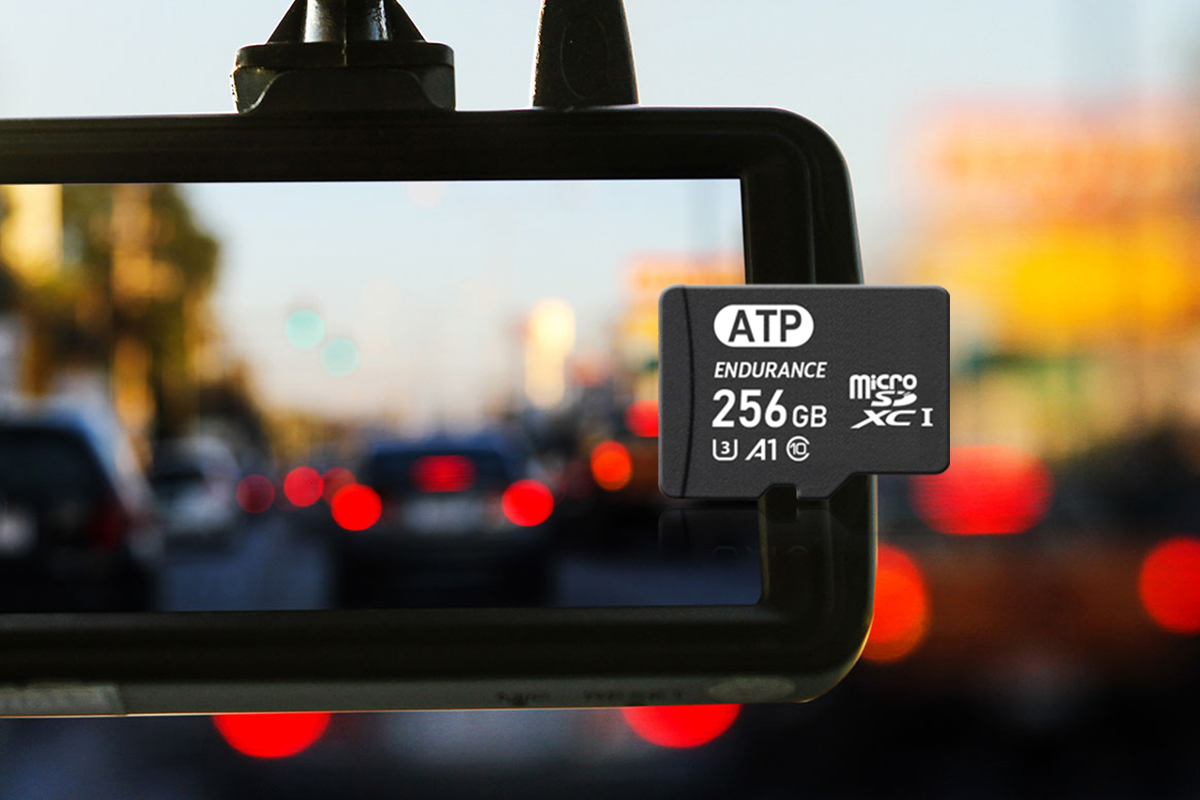
As the resolution and development of dashcam or DVR evolve, merely looking for high-capacity storage is not enough. To record videos non-stop for thousands of hours without compromising data integrity, you will need high-endurance memory cards.
Recording Challenges
- Non-Stop Operation. Dashcams/DVRs typically operate for extended periods of time. Recording over and over again may cause NAND storage failure on video.
- Latency Under Different Temperature Profiles. Both extreme heat and cold environments can affect flash memory cells and the performance of the storage media.
- Harsh Operating Conditions. Environmental conditions of the camera location contribute to flash degradation and can endanger the integrity of the data in it.
- Power Supply Instability. Any power flux or interruption may cause damage to the dashcam or storage device, thus corrupting data integrity.
What Should We Consider When Choosing a Memory Card for Recording? Endurance Matters
The endless writing/rewriting of camera recording causes NAND flash cells on the storage media to wear out, leading to possible video corruption and rendering the stored data useless when it is needed most.
- NAND P/E cycles may have a direct impact on storage lifetime. With different NAND architectures, endurance could have 2–3 times extension. In concrete terms, ATP's high-endurance 3D TLC microSD cards are rated up to 5,500 TB written (TBW), and the same NAND configured in pSLC mode is rated up to 12,670 TB.
- Wear leveling extends lifetime. Evenly distributing erase counts to each block can extend the lifetime of the storage device on the recording media.
Endurance = Recording Hours = Capacity?
As demand for longer recording time increases, unsurprisingly, more and more high-capacity memory cards are successively being launched to fulfill the demands of the dashcam market. For example, when recording 4K video (100 Mbps), a 256 GB memory card can store about 5 hours and 40 minutes before it is full and overwritten for new recording.
Users may choose a super high-capacity memory card just for longer recording time, but as usage time increases and with the non-stop writing and rewriting day by day on storage devices, a high-endurance memory card with a suitable warranty is the one that stands out and provides higher recording quality as well as better data integrity for long-term recording.
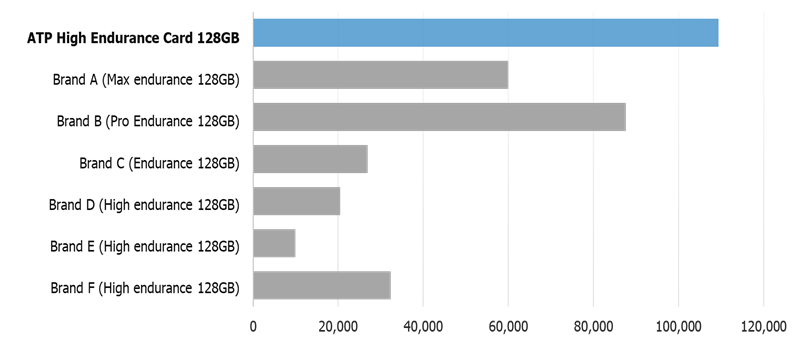
Table 1 shows total recording hours over the card's rated write life (with continuous overwrite), not a single fill.
| Capacity | HD (12 Mbps) | HD (17 Mbps) | Full HD (21 Mbps) | 4K (100 Mbps) |
|---|---|---|---|---|
| 256 GB | 198,974 | 152,157 | 123,175 | 25,867 |
| 128 GB | 99,487 | 76,078 | 61,587 | 12,933 |
| 64 GB | 49,744 | 38,039 | 30,794 | 6,467 |
| 32 GB | 24,786 | 18,954 | 15,344 | 3,222 |
Table 1. Estimated non-stop recording hours (lifetime, with continuous overwrite) with ATP high-endurance card.
Low Latency: Fast Response is Critical
Users expect their systems to be ready with fast response for evidence recording. Taking the drive recorder as an example — after power-on, the bootup time depends on the embedded memory, yet the time required to be ready for recording and succeeding programming depends on the external/removable storage, such as SD/microSD cards.
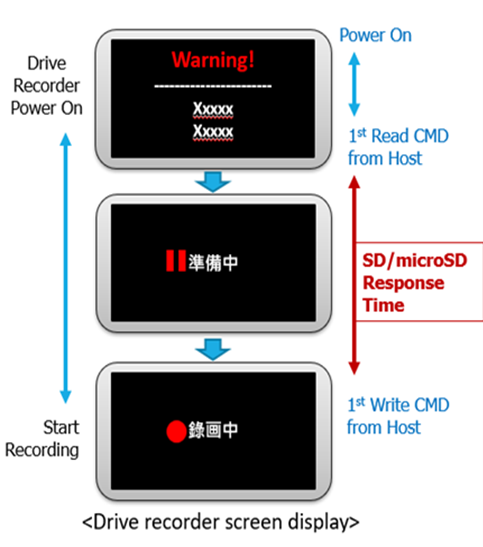
High-endurance memory cards built for dashcam recording can be ready to record up to ~90% faster than other commercial cards at room temperature (+25°C), and 40–45% faster at temperature extremes (−20°C / +60°C), which can effectively help the critical video being recorded.
| Temperature (°C) | ATP High-Endurance Card | Other Normal Cards |
|---|---|---|
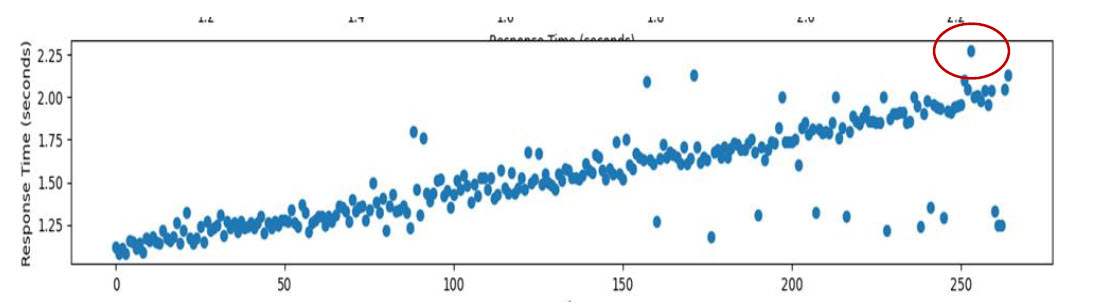
| @ −20°C | 2.25s | 4s |
| @ +25°C | 0.9s | 12s |
| @ +60°C | 7.5s | 12.5s |
Table 2. Maximum response time(s): fast response in any temperature scenario.
Note: Figures are maximum (worst-case) response times captured in dirty state (latest 250 cycles of a ~18-hour power-on/power-off test), not steady-state averages. The ATP and comparison cards are different sample populations, so values reflect the worst case measured at each temperature and are not intended as a monotonic curve across temperature.
Workload Matters
To understand the lifetime and quality of recording, information from the host and memory storage may be a key indicator. The ATP SD Life Monitor tool can be applied for product development.
1. Workload Inspection. On Windows, the ATP SD Life Monitor tool provides health status reports and card identification information. Furthermore, with the additional “Workload Inspection” pie chart, users can quickly check the write operation and file size by the host systems.
Considering the NAND flash page size and FW algorithm, ATP provides recommendations and more information for the host devices' program data based on the multiples of minimum data transfer size in the SD/microSD card datasheet. Please contact your regional representative for more information.
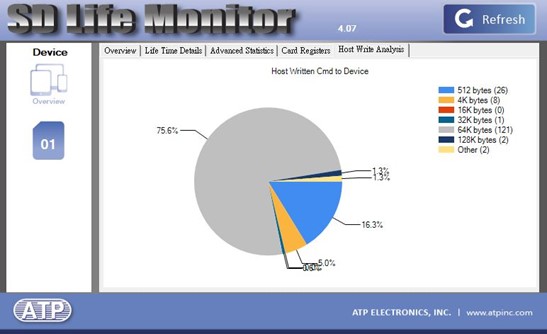
ATP Joint Validation Service with host workload inspection can provide customers a comprehensive solution on both hardware and software concerns. For more information, please check with your local representative or watch on YouTube.
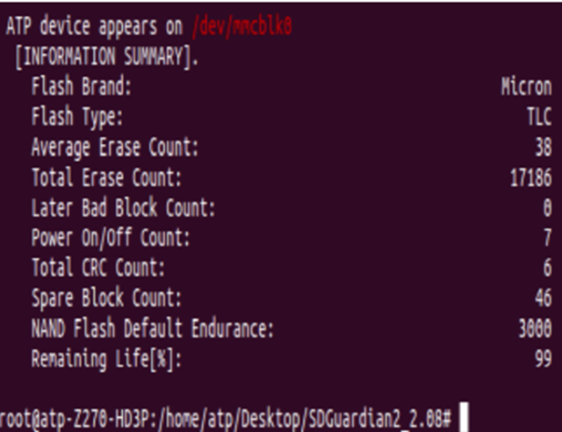
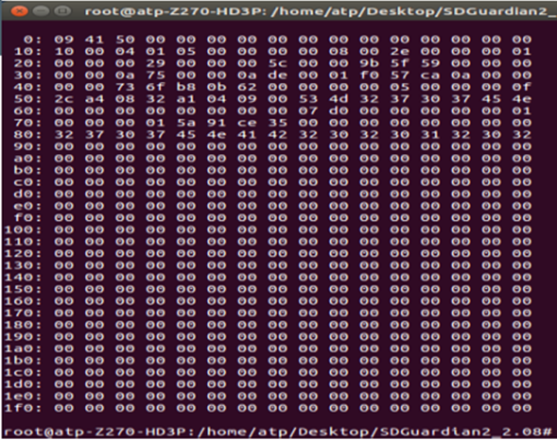
2. Linux tools. On Linux, customers can install the ATP SD Guardian tool that has a user-friendly interface for information display, or refer to the ATP Command 56 guidelines, which can directly issue SD vendor commands for software integration.
| ATP SD Guardian | Command 56 |
|---|---|
 |
 |
microSD for 24/7 Surveillance: Features and Endurance
Dashcams and continuous surveillance share the same core stress — non-stop writing — but a fixed surveillance camera adds uncontrolled temperature, abrupt power cuts, and years of unattended service. Two questions decide the card choice.
Which microSD card features matter most for 24/7 video surveillance workloads?
For 24/7 surveillance the features that matter most, in order, are: write endurance, sustained write performance, wide-temperature operation, power-loss protection, data-integrity firmware, and health monitoring. Endurance comes first because a camera writes continuously; specify by terabytes-written and wear leveling, not by capacity. Sustained write speed comes next — surveillance depends on the floor of write performance, not the burst peak, so a card certified to Video Speed Class V30 (a guaranteed 30 MB/s sustained) is what prevents dropped frames; ATP's 4KB page management and SLC-caching algorithm keep that floor high while cutting random-access latency by about half.
Wide-temperature −40°C to 85°C operation in a sealed, water/dust- and ESD-resistant System-in-Package (SiP) body handles outdoor and in-cabinet heat. Firmware-based, data-at-rest power-loss protection matters because cameras lose power without warning — it protects the firmware, the logical-to-physical mapping table, and data already committed, though (because the form factor has no on-board capacitors) it cannot guarantee the single write in flight at the instant of power loss completes (Part 2 details the word-line-level recovery mechanism). Data-integrity firmware — AutoRefresh for read-disturb, Dynamic Data Refresh for retention, and Auto-Read Calibration — matters because surveillance footage is also read back, and repeated reads plus heat degrade stored data. Finally, SD Life Monitor reports remaining life so a card is replaced on schedule instead of failing mid-incident.
The honest exception: an indoor camera in a climate-controlled room that is easy to swap can run adequately on a quality consumer card — the industrial feature set earns its cost once recording is continuous, temperature is uncontrolled, power is unstable, or the camera is hard to reach.
How many write cycles can industrial microSD cards handle in continuous recording systems?
Industrial microSD endurance is expressed in total terabytes written (TBW), not a single “write-cycle” figure, because the effective number of program/erase (P/E) cycles a card delivers depends on how well its firmware handles wear leveling and write amplification. On ATP's current industrial microSD line, 3D TLC cards are rated up to 5,500 TB written, and the same 3D TLC NAND configured in pSLC mode is rated up to 12,670 TB — the high-endurance recording NAND is built around roughly 5,000 P/E cycles, and pSLC mode raises effective endurance by close to an order of magnitude by storing one bit per cell instead of three.
In practical terms, ATP's own testing (Table 1 above) shows a 128 GB high-endurance card sustaining on the order of 99,000 hours of continuous HD recording at 12 Mbps — roughly 61,000 hours at Full HD (21 Mbps) and 12,900 hours at 4K (100 Mbps). The critical caveat: those TBW and recording-hour numbers are rated under sequential writes in a best-case scenario. A real surveillance workload is mixed, so it reaches end-of-life sooner — size the card against your own measured write rate and track true wear with ATP's SD Life Monitor rather than reading the datasheet number as a field guarantee.
Conclusion
ATP Electronics recently introduced its new 3D triple-level cell (TLC) S750/S650 Series High-Endurance SD and microSD memory cards built for continuous video recording. They meet the high endurance, low latency, and built-to-last data storage requirements of dashcams and digital video recorders (DVRs), as well as surveillance systems, autonomous vehicles, and other write-intensive applications.
For more information on ATP's new S750/S650 Series SD and microSD memory cards, visit the ATP website or contact an ATP Representative.
Frequently Asked Questions (FAQ)
Q1: Which microSD card features matter most for 24/7 video surveillance workloads?
A: Write endurance matters most, followed by sustained write performance, wide-temperature operation, power-loss protection, data-integrity firmware, and health monitoring. Endurance leads because continuous recording exhausts a card's write budget long before its capacity fills, so specify by terabytes-written (TBW), not gigabytes. Sustained (not burst) write speed at Video Speed Class V30 prevents dropped frames; −40°C to 85°C operation in a sealed System-in-Package body survives outdoor and in-cabinet heat; firmware-based, data-at-rest power-loss protection guards against abrupt camera shutdowns; AutoRefresh, Dynamic Data Refresh, and Auto-Read Calibration counter the read-disturb and retention loss that build up over years of read-back; and SD Life Monitor flags a card for replacement before it fails.
Q2: How many write cycles can industrial microSD cards handle in continuous recording systems?
A: Industrial microSD cards are rated by total terabytes written (TBW) rather than a single write-cycle number, because effective program/erase (P/E) cycles depend on wear leveling and write amplification. ATP's current 3D TLC microSD cards are rated up to 5,500 TB written, and the same NAND in pSLC mode up to 12,670 TB; the high-endurance recording NAND is built around roughly 5,000 P/E cycles, with pSLC mode adding close to an order of magnitude by storing one bit per cell. For a 128 GB card, ATP's testing shows about 99,000 hours of continuous HD (12 Mbps) recording. These figures are rated under sequential writes, so a mixed surveillance workload will reach end-of-life sooner — size against your measured write rate and confirm with SD Life Monitor.
Q3: What is the difference between TBW and P/E cycles for a memory card?
A: TBW (terabytes written) is the total amount of data a card is warranted to write over its life; P/E (program/erase) cycles count how many times each NAND cell can be erased and rewritten. TBW is the more useful spec for buyers because it already accounts for the card's capacity, wear leveling, and write amplification, whereas a raw P/E number describes only the bare NAND. To convert your workload to TBW, multiply your daily write volume by the number of days you need the card to last, then choose a card rated above that with headroom.
Q4: Is a higher-capacity microSD card the same as a longer-lasting one for continuous recording?
A: No. Capacity determines how much footage fits before the card overwrites the oldest data; endurance (TBW) determines how long the card survives being written to continuously. A large consumer card can hold days of video yet wear out in months under 24/7 recording, while a smaller high-endurance card lasts far longer. For continuous recording, choose endurance first and capacity second.
Q5: Do I always need an industrial microSD card for surveillance, or is a consumer card ever enough?
A: Not always. A consumer card can be adequate for an indoor camera in a climate-controlled room that records intermittently and is easy to reach and replace. The case for an industrial card becomes compelling the moment any one of those conditions changes: continuous 24/7 recording, uncontrolled or outdoor temperature, unstable power, or a camera that is remote or hard to service. Match the card grade to the workload and environment, then weigh it on total cost of ownership rather than unit price — one field failure of a hard-to-reach camera usually costs more than the card.