Dashcam memory cards can wear out as recording time increases, while high/low temperatures shift NAND voltage distribution. Part 2 of this series presents the three most frequent causes of data corruption — voltage shifts, read disturbances, and sudden power loss — and the firmware mechanisms ATP uses to fix them.
As mentioned in Part 1: Endurance, Latency, and Workload Considerations for Choosing Dashcam Memory Cards, many user behaviors may cause NAND storage failure, such as long-term recording, environmental conditions, or power supply instability. We present the three most frequent causes of data corruption, their fixes, and an enhanced analysis approach based on NAND technology and user behaviors.
Issue 1: NAND Flash Voltage Shifts
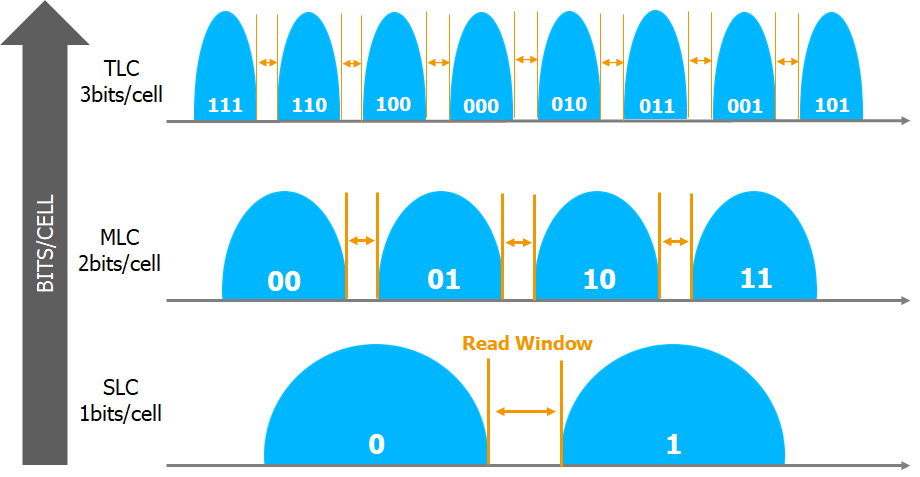
Flash may wear out as recording time increases, with other factors such as high/low temperatures causing dynamic voltage distribution. DVRs have largely embraced memory cards using 3D triple-level cell (TLC) NAND. While benefiting from NAND technology innovation's higher density at an affordable price, the smaller read window's difficulty for bits per cell results in read errors (refer to Figure 1).
ATP Solutions: Read Retry + Auto-Read Calibration (ARC)
In order to recover from bit errors and read the proper information, it is necessary to optimize the reference voltage inside the read window. The effectiveness of the Read Retry and Auto-Read Calibration (ARC) mechanisms is demonstrated below.
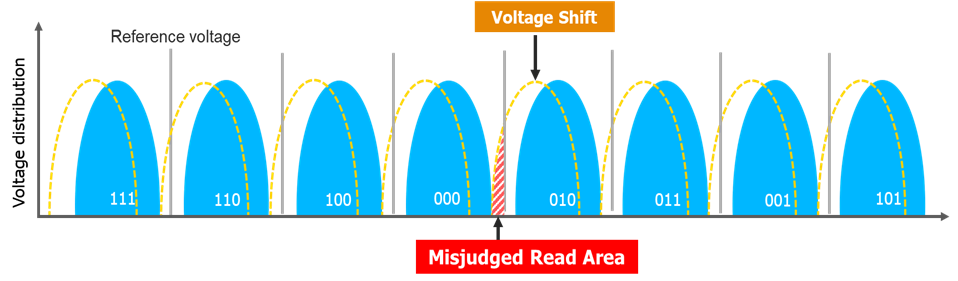
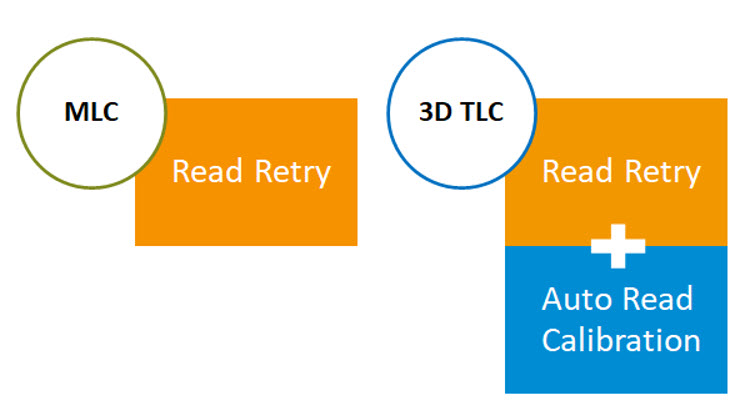
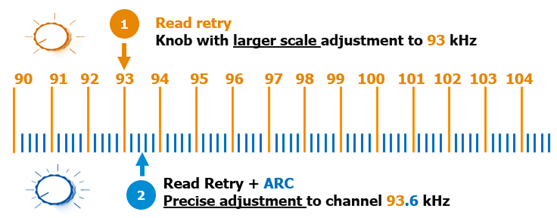
ATP SD cards automatically activate Read Retry when the voltage distribution shifts. Read Retry is a scale of voltage calibration methods to find a reference voltage for data reading. If the read still fails from bit errors beyond the ECC threshold and cannot be judged correctly by the Read Retry scale, a subtle and more precise voltage adjustment, Auto-Read Calibration (ARC), will be applied.
This feature can be likened to listening to a radio channel. For example, you want to listen to channel 93.6 kHz without noise. Read Retry allows you to set the knob to 93 kHz. With Read Retry plus ARC, you can make a precise adjustment to 93.6 kHz.
Issue 2: Read Disturbances
In the previous section, we mentioned that there are more and more interferences between neighboring cells with NAND evolution, which may cause lower margins for error handling. After long-term and massive read operations, electric charges in the cell may have an impact on the voltage threshold and lead to read disturbances.
ATP Solution: Read Disturb Protector — monitor both error bits and read counts
Read Disturb Protector aims to prevent read disturbance by monitoring both error bits and read counts in each read operation. Once the error bits reach the pre-set threshold1, the ATP firmware (FW) will take action by moving data from the high-risk block to a healthy block and marking the original block. Depending on the risk level, the firmware will determine whether to re-use the original block or mark it as a bad block.
1 ECC threshold may vary depending on FW & BOM configuration.
Note on feature names: on ATP's current product pages, these data-integrity functions appear under their product names — AutoRefresh (read-disturb protection, the behavior described here as Read Disturb Protector), Dynamic Data Refresh (data-retention refresh), and Auto-Read Calibration (ARC).
Issue 3: Sudden Power Loss
ATP Solutions: Back-up Mechanism and SPOR (Sudden Power-Off Recovery)
3.1 Back-up firmware mechanism
Any unplanned power outage could result in vital data being lost or corrupted. The worst-case scenario is memory card malfunction if a power outage happens while updating system tables. System tables, including the FW/ISP code, FTL info table, and boot table, are contained in the NAND flash SLC-mode blocks.
Although the SLC-mode blocks are sturdy, backup tables are kept in a different system block to prevent the crash of the main system tables. As a result, the data on the SD card can be accessed from either the primary system tables or the backup system tables.
3.2 ATP Sudden Power-Off Recovery (SPOR)
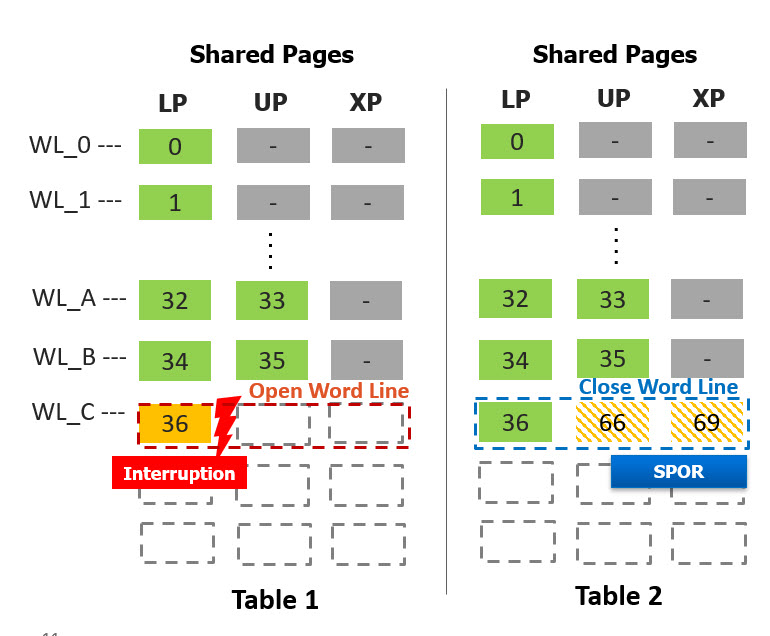
The basic unit of a memory chip is a cell, and the cells are arranged in a row called a word line (WL). The lower page, upper page, and extra page are paired pages in the TLC architecture that share the same word line. Data corruption and data integrity issues may result from incomplete programming in the same WL (an open word line).
To save as much data as possible, ATP Sudden Power-Off Recovery (SPOR) firmware will fill dummy patterns in the remaining cells of the same WL so as to complete the WL programming (close the word line).
Taking Figure 5 below as an example, the ATP SPOR firmware mechanism closes the word line containing page 36 by filling paired pages 66 and 69 with a dummy pattern. Closing the word line protects the data already programmed in page 36 — that is, data at rest. Because the SD/microSD form factor has no on-board capacitors, this firmware-based protection does not guarantee that a host write still in flight at the instant of power loss is committed; it safeguards the firmware, the mapping tables, and data that has already been programmed.
Advanced Card Analysis for SiP (System-in-Package) Memory Cards
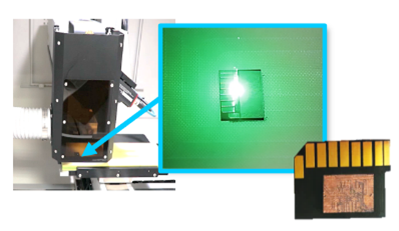
Memory cards are IP67/IP57-certified and manufactured using a System-in-Package (SiP) wafer/die process that integrates components within a single package, making them resistant to water, dust, and shock. However, SiP protection also makes memory cards difficult to analyze at component level. ATP's solution is the Analysis Methodology for SiP Memory Cards, which features a uniquely designed substrate and debug tool that make this mission “possible.”
| ATP-Developed Hardware Design | Solder Mask Removal by Laser | ATP's Own Customized Debug Tool |
|---|---|---|
 |
 |
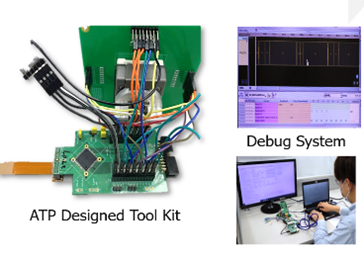 |
Figure 6. ATP Analysis Methodology for System-in-Package Memory Cards.
For more information, please watch the ATP Mission Impossible video on YouTube.
Why Dashcam Manufacturers Should Consider Bundling ATP High-Endurance Memory Cards
For over 30 years, ATP has been a leading manufacturer with world-class hardware/firmware (HW/FW) capabilities. It uses leading-edge technologies to ensure its products' maximum reliability and extended endurance and can adjust to a variety of usages to fulfill customers' specific application requirements and conditions.
Customization and Joint Validation
ATP's own-developed firmware and hardware design, together with supporting mass production infrastructure, are fully customizable to meet customers' criteria:
- Software joint integration (e.g., SD Life Monitor)
- Compatibility tests
- Function/performance enhancement
- Signal measurement
- Additional tests (industry standard, Power Cycling Test)
Manufacturer's Warranty Policy
The new ATP S650/S750 Series SD/microSD cards are specifically purpose-built for write-intensive applications such as dashcams, DVRs, and surveillance cameras; as such, there is no need to worry that the warranty will become void due to intense video recording use.
- S650 Series memory cards in native TLC are covered by a 3-year warranty.
- S750 Series cards configured as pSLC are covered by a 5-year warranty.
Conclusion
The new ATP S650/S750 Series SD/microSD cards meet the high endurance, low latency, and built-to-last data storage requirements of dashcams and digital video recorders (DVRs), as well as surveillance systems, autonomous vehicles, and other write-intensive applications.
- High endurance ensures long-time recording. ATP memory cards are built for non-stop video recording and are rated up to 5,500 TB written (3D TLC) and up to 12,670 TB in pSLC mode. Per Part 1's tested figures (12 Mbps HD), that translates to roughly 99,000 hours of continuous recording on a 128 GB card and roughly 199,000 hours on a 256 GB card.
- Low latency for critical recording. High-endurance memory cards built for dashcam recording are ready to record in about 1 second at room temperature (longer at temperature extremes), with response times up to ~90% faster than consumer-rated cards at +25°C and 40–45% faster at −20°C/+60°C (see Part 1, Table 2).
- Data integrity protection with Read Retry, Auto-Read Calibration (ARC), and read-disturb protection (AutoRefresh) makes sure that stored data remains error-free even in the face of reference voltage shifts or read disturbances.
- Sudden power failure solution. The ATP Sudden Power-Off Recovery (SPOR) mechanism closes open word lines to keep committed data and system tables safe and accessible when unexpected power loss happens — firmware-based, data-at-rest protection consistent with the card form factor's lack of on-board capacitors.
- Customization and warranty. With ATP's manufacturing capabilities to customize firmware and hardware, as well as its solid warranty policy, dashcam/DVR/surveillance camera vendors and their customers can rest assured in ATP's high-endurance memory cards.
For more information on ATP's new S750/S650 Series SD and microSD memory cards, visit the ATP website or contact an ATP Representative.