Industrial SD and microSD cards are the edge storage that keeps IoT/IIoT gateways collecting, buffering, and analyzing data at remote sites — through temperature extremes, power instability, and connection outages. This article explains why gateways need local storage, how cloud and edge tiers divide the work, and what makes a memory card dependable enough to run unattended.
Key Takeaways
An IoT gateway is only as dependable as its local storage. When the link drops or the power flickers at a remote site, the memory card on the gateway is what decides whether data survives and operation continues.
- For remote IoT deployments, a tiered architecture works best: time-critical data is captured, stored, and pre-processed on the gateway’s industrial SD or microSD card, and only the reduced, aggregated data travels to the cloud for long-term analytics. This offloads the network, cuts transmission costs, and keeps decisions local.
- Power-loss protection on a memory card is firmware-based and protects data at rest — not data in flight. ATP’s Sudden Power-Off Recovery (SPOR) protects the card firmware, the mapping table, and data already committed, and restores the card to a consistent state on power-up. Because SD/microSD cards have no on-board capacitors, the one write in progress at the instant power is cut is not guaranteed to finish — design a clean shutdown or buffer critical writes at the system level.
- Remote sites punish storage physically. ATP industrial cards operate from −40°C to 85°C and are built in a System-in-Package (SiP) body that seals the die against dust, humidity, ESD, and shock/vibration — the conditions inside a fanless roadside, offshore, or in-cabinet enclosure.
- Local storage keeps the gateway working offline. The card doubles as the boot device and as a buffer for data waiting to reach the cloud, so an internet outage interrupts transmission, not operation — and a removable card can be swapped or upgraded without replacing the gateway.
- You don’t always need an industrial card. For light, intermittent writes inside a climate-controlled, easily serviced enclosure, a quality consumer card can be adequate. Industrial grade becomes decisive when writes are continuous, temperature is uncontrolled, power is unstable, or the site is hard to reach.
What Is an IoT Gateway?
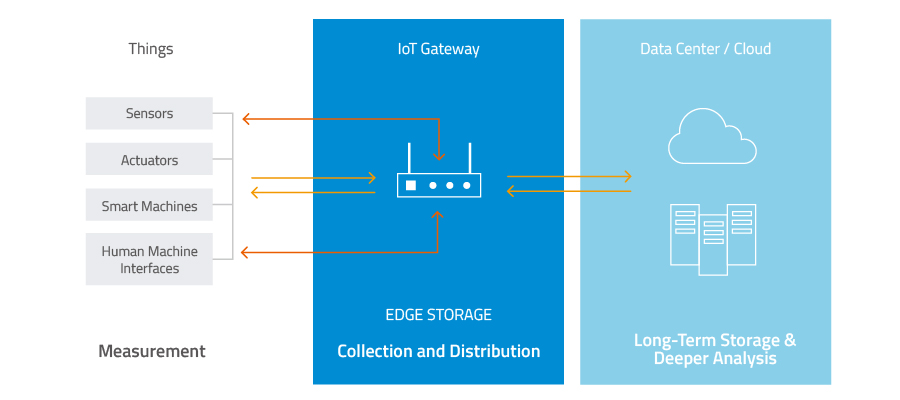
A gateway is an important component of the Internet of Things (IoT) and industrial IoT (IIoT) ecosystem. As its name implies, a gateway is a device that connects things (sensors, actuators, and intelligent devices) to the cloud, functioning as a bridge or intermediary where all data going to or coming from the cloud goes through. For data that may not have to be transferred to the cloud, a gateway also provides storage and fast analytics at or near the source to enable intelligent, time-critical decisions.
Cloud vs. Edge Storage: What’s the Difference?
Data is transforming the way industries operate. In the field of energy exploration alone, a 2015 Cisco analysis noted that a typical offshore oil platform in a remote location generated 1 TB to 2 TB of data daily. Most of the data, which came from sensors, surveillance cameras and many other sources, was time sensitive. Moving all this data to a central location using a satellite connection, however, could take about 12 days.
Cloud storage refers to storing and accessing data over the Internet. It allows retrieval of files from any device in any location as long as Internet connection is available. Several users may access the same files simultaneously if they have the necessary passkey. Due to limited bandwidths, costly network services, and unstable connection in some areas, relying on the Internet may result in delays that will render the data irrelevant or cause risks to life or property especially for applications that require real-time processing and retrieval.
Edge storage refers to storing, analyzing and processing critical data at or closer to the data source rather than in a centralized or cloud-based location. It offloads the network, cuts transmission costs, and optimizes the data collected for immediate insight or swift response. In applications where data needs real-time processing and does not have to be stored in a central location for data warehousing or deeper analytics, edge computing is a more viable alternative.
| Cloud Storage | Edge Storage |
|---|---|
|
|
Table 1: Ideal use cases for cloud and edge storage
What Storage Architecture Works Best for Remote IoT Edge Deployments?
A tiered architecture works best for remote IoT edge deployments: industrial-grade local storage on the gateway handles time-critical capture, buffering, and analysis at the source, while the cloud holds the reduced, pre-processed data that warrants warehousing and deeper analytics. The split follows directly from the table above — real-time response, at-source visualization, and outage buffering belong at the edge; big-data processing and machine learning belong in the cloud. At a remote site, the deciding constraint is the link: when bandwidth is limited, costly, or intermittent, the local tier is what keeps the site autonomous.
Specifying that edge tier means specifying for the site, not the office. An unattended cabinet sees temperature swings, dust, vibration, and unstable power — and nobody is there to press reset. Four requirements follow: an industrial operating range of −40°C to 85°C so the card stays in specification through winter cold starts and heat-soaked enclosures; a sealed System-in-Package (SiP) build that protects the die against dust, humidity, ESD, and shock; firmware-based power-loss recovery for supplies that sag and cut without warning (covered in the next section); and health monitoring — ATP’s SD Life Monitor — so a weakening card is replaced on a planned visit rather than after a failure. Removability is the quiet fifth advantage: ATP’s industrial SD and microSD cards can be swapped or upgraded in the field without touching the gateway itself.
The architecture question also has an honest inverse. If a site has reliable power, climate control, and a dependable high-bandwidth link — and no real-time requirement — a cloud-first design with a modest local cache is entirely reasonable, and the industrial premium is hard to justify. The tiered, industrial-grade edge earns its cost where the link or the environment cannot be trusted.
Why Do IoT Gateways Need Edge Storage?
Whether data will ultimately be transferred to the cloud or will stay on the premises, gateways are important components of the IoT/IIoT ecosystem. Why do we need gateways? Why not send all data gathered by sensors and devices directly to the cloud? In the IoT/IIoT, every connected device generates astronomical amounts of data. Sensors alone easily create a deluge of data by the second; however, they have limited networking connectivity capabilities. With gateways, sensors can have a single point of contact to external networks.
Below are some of the advantages of using IoT/IIoT gateways:
- Data Filtering, Aggregation and Volume Minimization. By pre-processing data at the edge, IoT/IIoT gateways provide critical analysis closer to the source, so not all data have to be transmitted to the cloud. This prevents the sheer volume of unnecessary data from inundating the network and resulting in higher transmission and storage costs. Pre-processing before data is sent to the cloud can include converting the data to another format, packaging, validating, and sorting according to a particular sequence. It could also mean eliminating unnecessary details or aggregating/summarizing data for analysis. When data is pre-processed on-site or close to the source, information can be transmitted to the cloud in smaller footprints.
- Faster Response Times and On-Site Intelligence. By providing local processing and storage capabilities, IoT/IIoT gateways enable near-real-time delivery of services, insight and control over connected devices.
- Reliable Offline Operation. Internet connectivity has advanced by leaps and bounds, but occasional outages, slow connections, low bandwidth and other issues still hover. In some cases, failure of Internet connections can cause undue risks to assets and infrastructure, and negatively impact business decision making. Gateways provide Internet-independent dependability, allowing reliable backup to ensure uninterrupted communication and control.
- Better Security. Since sensors and devices are connected to the gateway and not directly to the Internet, this reduces the vulnerability of sensors/devices getting hacked. Gateways protect the data being transmitted to the cloud from leaks, and prevent unauthorized control of sensors and devices.
What Storage Challenges Do IoT Gateways Face?
In this age when data is touted as the new currency, the IoT/IIoT presents numerous opportunities for transforming businesses using actionable insights. Fast, secure intelligence at the edge enables real-time analysis, which in turn translates to better processes and better bottom lines.
As billions of connected devices whip up immense amounts of data by the second, what are some of the most common requirements for storage in this increasingly expanding IoT network?
- Space Constraints. Most IoT/IIoT devices and components such as gateways are small, as they are typically deployed in settings with space limitations. Memory solutions must therefore be compact, without compromising performance and storage capabilities.
- Diverse Usage. Data from sensors and devices typically vary from large files such as those generated by surveillance cameras and tiny log files from environmental sensors. The wide gamut of application usages reflects vastly different input/output profiles, such that it is nearly impossible for a one-size-fits-all solution.
- Demanding Environments. It is not uncommon for gateways to operate 24/7, as sensors and devices are always on “live” mode and endlessly churning out streams of data. Dust, shock and vibration, and electrostatic discharge (ESD) on site require storage solutions that are robust and able to withstand such conditions. Ultra-compact gateways are usually fanless and storage solutions should also be able to endure wide temperature variations while stored and in operation.
- Data Reliability & Integrity. Devices deployed for industrial applications commonly face power losses and voltage fluctuations that could lead to data loss. As gateways typically hold both static and dynamic data in mixed workload scenarios, it is important to make sure that such data is protected from power loss and data corruption.
How Do Edge Gateways Prevent Storage Corruption During Power Instability?
Edge gateways prevent storage corruption during power instability at two levels — recovery firmware inside the storage device, and power design in the system — and dependable deployments use both. At the storage level, Sudden Power-Off Recovery (SPOR) is ATP’s firmware-based, data-at-rest power-loss protection: it protects the card firmware, the logical-to-physical mapping table, and data already committed to flash, and restores the card to a consistent state when power returns. That is what stops a brownout or an abrupt cut from corrupting files that were saved long before the event — or from leaving the card unable to mount at all.
What firmware alone cannot guarantee — on any SD or microSD card, because the form factor has no room for the capacitors that back power-loss protection on industrial SSDs — is that the single write in flight at the instant power is cut completes. A gateway designed for unstable power closes that gap at the system level: buffer critical writes, trigger a clean shutdown from the power-fail signal where the hardware provides one, and treat SPOR as the last line of defense rather than the whole defense.
Power events are not the only integrity threat between site visits. Data sitting in NAND accumulates read-disturb and retention errors over time, so the cards’ refresh firmware rewrites affected blocks before those errors become uncorrectable, and the SD Life Monitor reports remaining life so replacement is scheduled, not forced. Together — recovery on power loss, refresh between events, and visible health — these are what let a card run unattended for years at a site no technician visits.
ATP 3D NAND-Based Memory Cards Meet Growing IoT/IIoT Storage Needs
ATP’s industrial-grade SD and microSD cards based on 3D NAND technology meet the growing data storage needs of the IoT/IIoT. Thanks to these tiny and low-power yet powerful removable data collection solutions, gateways can store huge amounts of data closer to the source, providing local intelligence and ensuring Internet-independent operation even in the event of connection outages. Memory cards are also used as handy boot devices, conveniently storing the gateway operating system.
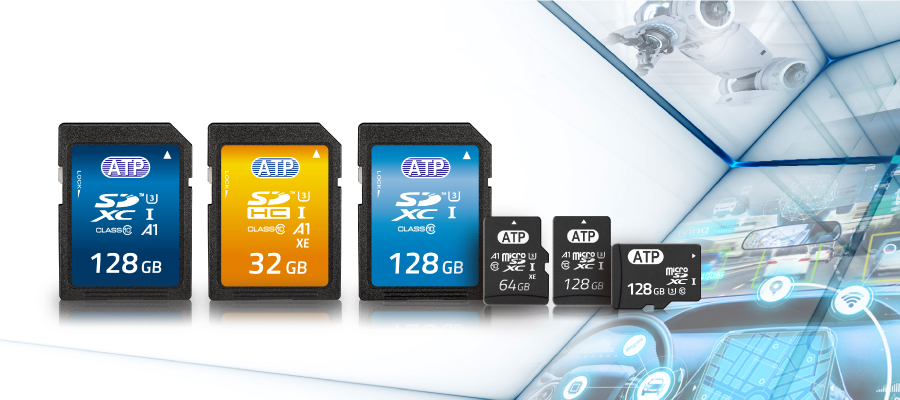
- Small Cards, Big Performance. ATP memory cards based on 3D NAND technology provide compact, robust and reliable storage whether locally or at the edge. Engineered to meet the escalating storage demands of the IoT/IIoT, ATP 3D memory cards offer high capacities for data-rich applications. The cards carry the SD Association’s A1 Application Performance Class rating, which specifies minimums of 1,500 random read IOPS, 500 random write IOPS, and 10 MB/s sustained sequential throughput. High-density and high-performance storage made possible through 3D NAND technology enables swift processing to deliver time-critical analytics near real time. The compact form factor offers small footprint ideal for space-constrained systems without compromising performance.
- Convenient Portability. Removable storage devices like ATP’s memory cards make it convenient to swap application programs and transfer files. It is also easy to replace memory cards; and, thanks to their compact size, they are light enough to bring to other locations.
- Wide Temperature Support. As of this article’s publication (2020), ATP 3D memory cards are built on floating gate architecture, a proven technology well suited to wide-temperature operation. With industrial temperature ratings of −40°C to 85°C, these memory cards can be depended on even in extreme temperatures.
- Rugged Design. System-in-Package (SiP) technology fortifies the durability of ATP 3D memory cards by encapsulating all exposed components, thus making the cards resistant to damaging elements such as dust, humidity, ESD, shock/vibration, and more.
- Built to Endure. As planar NAND process nodes shrank, bit error rates rose and endurance fell; 3D NAND stacks cells vertically instead of shrinking them further, restoring that margin. As of this article’s publication (2020), ATP 3D memory cards are built with multi-level cell (MLC) flash, taking advantage of all the benefits of 3D NAND technology without compromising endurance and data retention. The single-level cell (SLC) mode of ATP 3D memory cards can be an option for write-intensive environments, having 8-10 times higher endurance at half the density of the same card in MLC mode.
- Maximum Dependability. ATP 3D memory cards provide peace of mind, providing reliable backup and ensuring that data on-demand is available even when Internet connection is not available. In the event of power supply loss or fluctuation, Sudden Power-Off Recovery (SPOR) — a firmware-based, data-at-rest protection mechanism — protects the card firmware, the logical-to-physical mapping table, and data already committed to flash, and restores the card to a consistent state on power-up. Because SD/microSD cards have no on-board capacitors, the single write in flight when power is cut is not guaranteed to complete — protect that last write at the system level. In addition, the data refresh algorithm mitigates read-disturb errors by refreshing affected blocks before accumulated bit errors become uncorrectable, and the SD Life Monitor tool provides an easy way to check the health status of the memory cards.
- Better Privacy Control. Gateways provide local analysis of sensitive data for better privacy control, enabling data and generated insights to be more closely monitored and controlled. ATP memory cards fortify protection by building a security key that allows the gateway to recognize only qualified memory cards with the correct key, thus preventing unauthorized cards from being used on the gateway.
Conclusion
ATP 3D memory cards are ideal for industrial applications requiring secure, on-demand storage and backup such as building automation, maintenance and asset management, health care, security and surveillance systems and manufacturing, as well as automotive and transport applications such as advanced driver assistance systems (ADAS), in-vehicle infotainment (IVI), telematics, navigation and fleet management. As storage devices for IoT/IIoT gateways and other edge devices, ATP 3D memory cards allow critical data to be stored and processed close to the source to provide local intelligence and insights that could transform businesses.
For more information on ATP memory cards, please visit the ATP website or contact an ATP Distributor/Representative in your area.
Frequently Asked Questions
Q1: How do edge gateways prevent storage corruption during power instability?
A: Edge gateways prevent storage corruption by pairing recovery firmware in the storage card with system-level power design. ATP industrial SD and microSD cards use Sudden Power-Off Recovery (SPOR) — firmware-based, data-at-rest power-loss protection that safeguards the card firmware and the logical-to-physical mapping table, protects data already committed to flash, and restores the card to a consistent state when power returns. Because memory cards have no on-board capacitors, the one write in flight at the instant power is cut is not guaranteed to complete, so a well-designed gateway also buffers critical writes or performs a clean shutdown on power events. Between outages, refresh firmware and health monitoring keep stored data readable and flag a card approaching end of life.
Q2: What storage architecture works best for remote IoT edge deployments?
A: A tiered edge-plus-cloud architecture works best: industrial-grade removable storage on the gateway captures and pre-processes time-critical data at the site, and only reduced, aggregated data moves to the cloud for long-term analytics. The edge tier runs unattended, so it should be specified for the site, not the office: a −40°C to 85°C operating range, a sealed System-in-Package (SiP) build against dust, humidity, shock, vibration, and ESD, firmware power-loss recovery for unstable supplies, and health monitoring so a failing card is swapped on a planned visit rather than an emergency one. The cloud remains the right place for data warehousing, historical analysis, and machine learning — edge storage complements it rather than replaces it.
Q3: What is Sudden Power-Off Recovery (SPOR) on an SD card?
A: Sudden Power-Off Recovery (SPOR) is a firmware mechanism on ATP industrial SD and microSD cards that restores the card to its last consistent state after an unexpected power loss. It is data-at-rest protection: it safeguards the card firmware, the logical-to-physical mapping table, and data already committed to flash. It differs from the capacitor-backed power-loss protection on industrial SSDs, which uses stored energy to complete writes in flight after the supply drops — a memory card’s form factor has no room for those capacitors, so the single write in progress when power is cut is not guaranteed to complete. For continuous-write systems, pair SPOR with a system-level clean-shutdown or write-buffering policy.
Q4: Should IoT gateways store data at the edge or in the cloud?
A: Both — split by time-sensitivity. Data that drives real-time decisions, needs at-source visualization, or must survive connection outages belongs at the edge, on the gateway’s local storage; data for warehousing, big-data processing, historical analysis, and machine learning belongs in the cloud. The practical rule is to process and act locally, then send the reduced, aggregated results upstream — pre-processing at the gateway cuts transmission volume and cost. A deployment with reliable, high-bandwidth connectivity and no real-time requirement can reasonably run cloud-first with only a modest local cache.
Q5: What happens to data on an IoT gateway when the internet connection fails?
A: With local storage, the gateway keeps operating: it continues to collect, store, and analyze sensor data on its memory card, then transmits the backlog when the connection returns. Outages, slow links, and low bandwidth are routine at remote sites, and this offline continuity is one of the main reasons gateways carry edge storage at all. Two sizing consequences follow: local capacity must cover the longest realistic outage at the site’s data rate, and the card must tolerate the sustained writes that buffering implies — which is where industrial-grade endurance and health monitoring matter. Without local storage, data generated during an outage is simply lost.