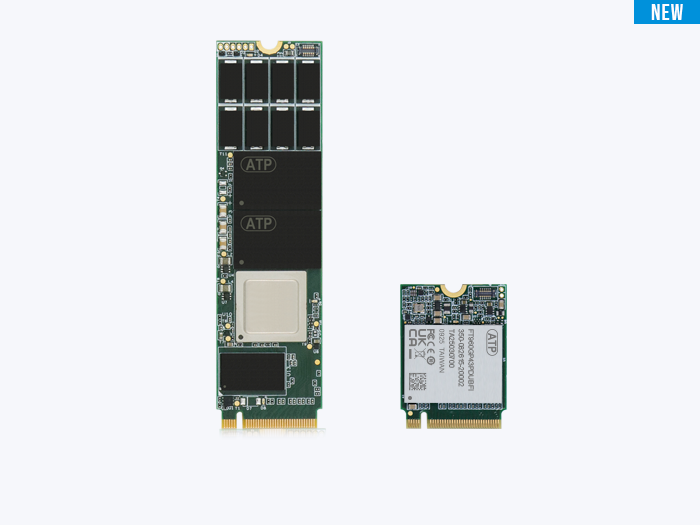
Edge AI systems run inference where the data is produced, so the storage tier has to deliver data at the pace of near real-time decisions. That makes two properties decisive: how low the latency is, and how consistently the drive holds it under sustained, 24/7 edge conditions.
Based on a presentation at Flash Memory Summit 2023 by John Cronise, Technical Business Development Manager, ATP Electronics
Key Takeaways
- Edge AI needs low-latency storage because the compute budget is tight. An edge node has a fraction of a data center's processing power, so time spent waiting on storage cannot be recovered elsewhere in the pipeline. NVMe SSDs communicate with the host over PCIe with no moving parts, completing I/O in microseconds where a hard drive takes milliseconds.
- For 24/7 edge AI, latency consistency matters more than peak speed. Write amplification, background garbage collection, and thermal throttling can each cause latency spikes under sustained load. Industrial NVMe SSDs counter all three — firmware that manages the Write Amplification Factor (WAF), TRIM with over-provisioning and wear leveling, and passive thermal solutions that keep the drive below its throttling threshold.
- SSD latency sits in the inference path only when data must move at inference time. If the model and its working set are fully resident in memory, storage latency shapes boot, model loading, and result logging rather than each inference. It becomes decisive when models are swapped, input data exceeds memory, or results must be written to a deadline.
- Rugged edge AI storage is layered, not a single feature: wide-temperature operation (−40°C to 85°C), managed endurance, thermal management, power-loss protection, and a fixed bill of materials for long-term supply. Each layer covers a different edge failure mode.
- Not every edge AI node needs industrial grade. Indoor, climate-controlled deployments with moderate write loads are often well served by commercial-grade NVMe such as ATP's Momentum line; the industrial premium earns its place where temperature extremes, continuous writes, or unattended operation apply.
Solid state drives (SSDs) utilizing NAND flash memory provide significant advantages over traditional hard disk drives (HDDs) in terms of speed, durability, and energy efficiency when dealing with large pools of data and artificial intelligence (AI) models.
Unlike HDDs, SSDs do not have mechanical parts and thus have lower latency and can access random data faster, making them crucial for high-speed AI processing, especially when dealing with large datasets and intensive workloads.
NAND flash storage devices, specifically those that comply with the NVMe protocol over the PCIe interface — with features such as multiple namespaces and NVMe over Fabrics (NVMe-oF) — alongside system-level interconnect technologies such as CXL™, provide the flexibility and utility to create AI system architectures that are robust, reliable, and can unify the scattered data efficiently.
SSDs Drive High-Performance Edge Computing
As billions of devices become connected on the Internet of Things (IoT), huge quantities of data are being collected. Sending all the data to the cloud is creating bottlenecks, driving computing to the edge of the network so data is near enough and processing is fast enough to churn out near real-time actionable insights.
Gartner projected that by 2025, 75% of enterprise-generated data would be processed outside a traditional data center or cloud.
AI applications implemented by edge computing systems are not only data heavy and compute intensive. They are also often mission- and safety-critical, requiring storage that can optimize the performance and responsiveness of edge servers.
NAND flash storage devices, particularly industrial-focused NVMe drives, are increasingly being adopted in AI and edge computing systems. They offer faster read/write performance, lower data access latency, lower power consumption than hard disk drives, and high endurance. They provide the utility in analytical models at the edge and in IoT applications. Here, data is acquired, cached, and lightly processed so that it can be used to make real-time decisions before, possibly, being moved into larger data pools for further processing.
High performance and low latency increase the efficiency in these edge applications where compute power may be limited.
This includes industrial applications, surveillance, and autonomous vehicles.
Why Do Edge AI Systems Require Low-Latency Industrial SSDs?
Edge AI systems require low-latency SSDs because the entire point of computing at the edge is to act on data in near real time — and every moment the processor spends waiting on storage comes straight out of that response budget. They require industrial SSDs because the conditions at the edge — temperature extremes, sustained round-the-clock workloads, sites no technician visits for months — are precisely the conditions under which a drive's latency degrades.
Storage touches the edge AI pipeline at several points: capturing sensor and video streams, caching and lightly processing data for local decisions, loading models and parameters, and writing back results and logs. Because an edge node's compute is limited, a stall at any of these points is not absorbed the way a data center absorbs it — it surfaces as a missed frame, a delayed decision, or lost data. In mission- and safety-critical deployments such as autonomous vehicles and surveillance, the worst-case storage response, not the average, is what the system must be designed around.
This is where the industrial grade separates from the consumer grade. A consumer NVMe drive can post excellent burst benchmarks, then stall for milliseconds when background garbage collection kicks in, or throttle when a fanless enclosure heat-soaks. An industrial NVMe SSD is engineered for the sustained case: firmware that monitors and manages write amplification, TRIM support with over-provisioning and wear leveling to preserve endurance and steady response, and passive thermal solutions that keep the drive from throttling under load — so the latency your application sees on day 500 of continuous operation matches day one. For deployments outside climate control, industrial-grade drives also hold their specifications across a −40°C to 85°C operating range, where consumer drives are rated only 0°C to 70°C.
How Does SSD Latency Affect Edge AI Inference Performance?
SSD latency affects edge AI inference performance wherever data has to move from storage into memory at inference time: loading or swapping models, streaming input data too large to hold in memory, or fetching reference data from the drive. When the model and its working set are fully memory-resident, storage latency instead governs how fast the system boots and recovers, how quickly models update, and whether results and logs are written on time — it does not add to each individual inference.
That distinction decides how to specify the drive. Storage sits directly in the inference path when a system swaps between multiple models, reads datasets or feature stores from the drive, or buffers high-rate sensor streams on the SSD before processing. In those paths, each storage access adds to end-to-end response time, and the worst-case latency — not the average — sets what response the system can promise. Miss a logging deadline and you lose data; stall on a model swap and the pipeline waits.
The metric that matters most under continuous edge AI load is latency consistency. A drive's burst figures describe short transfers absorbed by its cache; sustained operation exhausts the cache and exposes background garbage collection, and heat build-up can push an unmanaged drive into thermal throttling mid-shift. Both appear to the application as unpredictable latency spikes — the difference between a video-analytics node that holds its frame rate and one that silently drops frames. If your edge AI system runs around the clock, specify the drive by its sustained worst-case latency, not the datasheet's burst figure.
Key Considerations for SSDs at the Edge
AI system design with SSDs revolves around maximizing data transfer rates, storage capacity, and understanding drive endurance.
There are three key considerations:
- Performance Optimization
- Endurance Optimization
- Thermal Management
Performance & Endurance Optimization
The performance side of this equation — latency, and how consistently it holds under sustained load — is covered above; managing endurance is what keeps that response steady over the drive's service life.
SSDs have a finite lifespan. NAND flash memory wears out and loses charge-holding capacity, and the SSD degrades over time. This is why data management plays a crucial role in maximizing SSD lifespan and performance.
SSDs employ NAND flash memory cells, which are arranged in pages and blocks. Data is written on pages, but the minimum unit of erasing is by blocks. This results in the NAND flash controller performing extra processes — this phenomenon is called write amplification, where the actual amount of physical data written to the flash memory becomes larger (amplified) compared with the amount of logical data written by the host. The numerical value is called Write Amplification Factor (WAF) or Write Amplification Index (WAI).
This unique behavior requires a different approach to optimizing writes to enhance the longevity and performance of the drive. In edge and IoT applications the file types and file sizes may be relatively well defined; however, the workload may be elastic. It is critical to optimize the data as much as possible to avoid unnecessary WAF/WAI and ensure long-term drive endurance.
At ATP, we pay close attention to write amplification and understanding SSD Write/Erase behavior.
- Regular monitoring ensures that write amplification challenges are identified and can be addressed.
- Small edge and IoT applications, potentially in remote locations, need the SSD to provide the long-term endurance and reliability.
- TRIM function support, over-provisioning, and wear leveling are some of the typical ways of managing SSD life expectancy and extending endurance.
Thermal Management
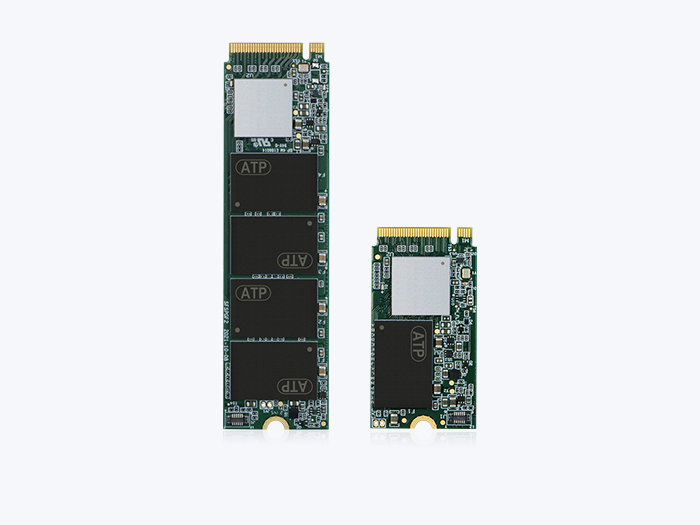
Overheating is a major challenge that could impact the performance of edge/IoT AI applications. High-performance, high-speed NVMe drives are particularly susceptible to thermal challenges. Common causes of overheating include multiple die stacking per integrated circuit (IC), controller heat and intensive components in the limited printed circuit board (PCB) space, especially for double-sided designs, and intense workloads.
Given such challenges, accurately modeling power dissipation is the first step in creating a thermal management strategy. Below we list important aspects of ATP's Thermal Management Strategy.
Determining the customer's system/mechanical/performance criteria.
We assess user applications and system specifications to have an overview of mechanical limitations, if any, and other factors that may cause overheating. Where space permits, a large heatsink is a simple solution.
We also consider operating and ambient temperatures, airflow within and outside the system, mechanical design, other heat-generating components that may contribute to the thermal challenges, as well as workload and performance enhancements.
We recommend interfacing the SSD with as much mass as possible. This includes using thermal interface material (TIM) to dissipate excess temperature to the enclosure and environment. TIMs act as gap fillers that improve thermal conduction from the drive to the heatsink and system enclosure.
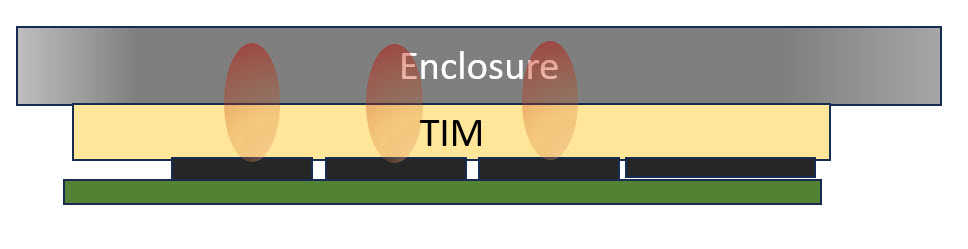
Simulation Tests from the Component Level. ATP uses Cadence Simulation Software to run component-level thermal simulation. It is a pure hardware simulation based on full-speed operation (worst-case scenario).
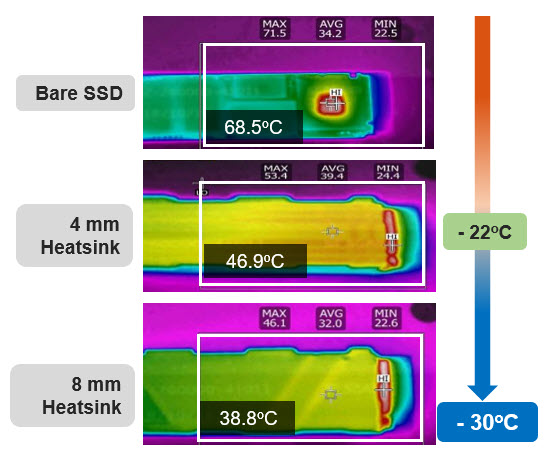
These simulation models have led to expanded passive thermal management solutions for industrial NVMe that lower the drive's composite temperature compared with a bare module in component-level simulation.
At ATP we have developed three unique passive solutions, including an ultra-thin graphene and copper foil solution for applications with weight budgets, intended to spread the load over a larger surface.
Testing the adhesive strength of the copper foil heatsink ensures reliability and excellent retention of the heatsink to the SSD. To evaluate the reliability of our copper foil solution, we perform resistance testing at high/low temperature on the adhesive layer to make sure that there is no deformation.
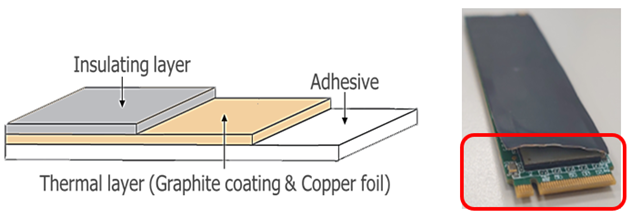
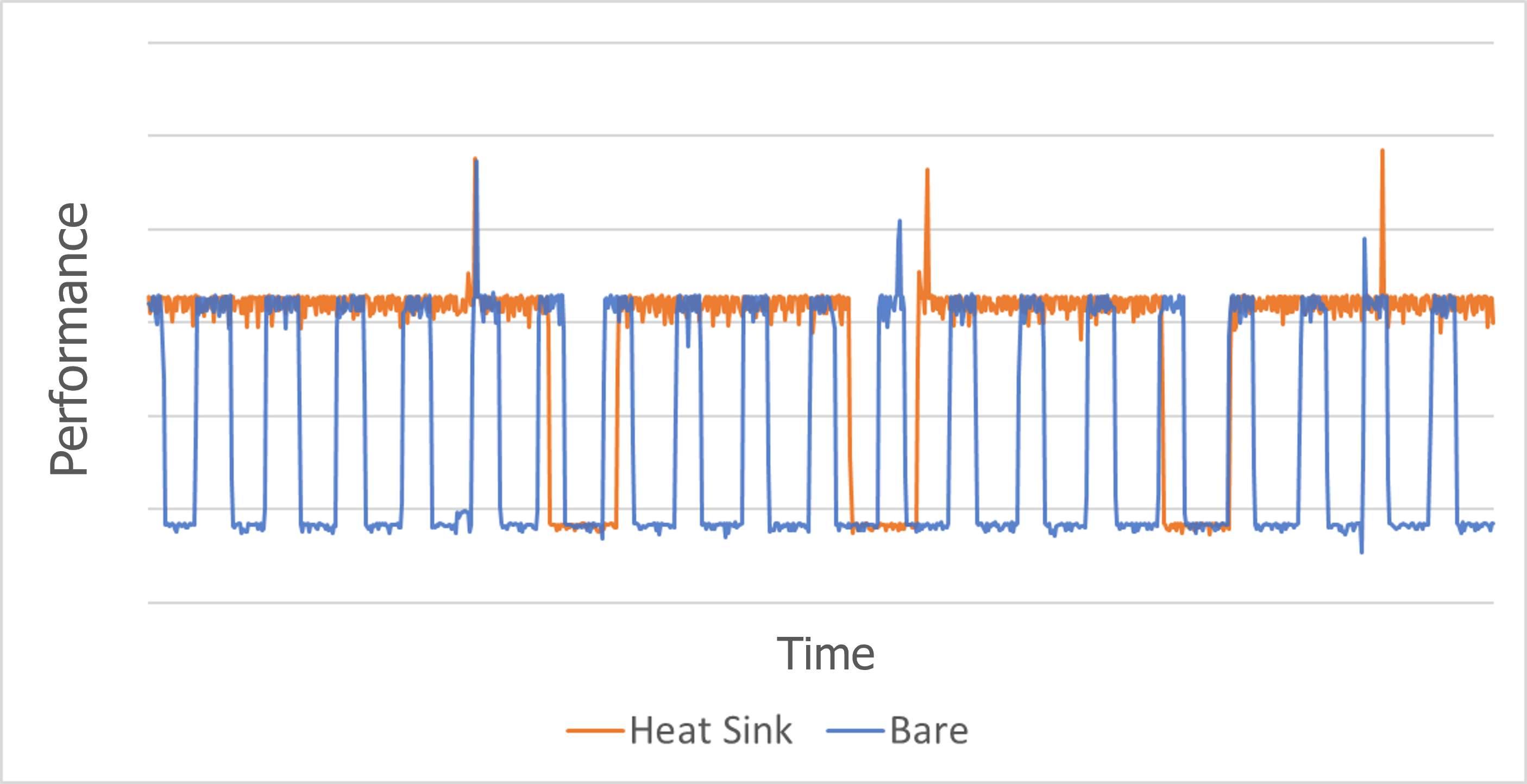
The following graphs show performance optimized with an 8 mm heatsink solution compared with a bare PCB.
ATP's 8 mm heatsink, complemented by airflow, dissipated heat and kept the drive below its throttling threshold under the tested workload and airflow conditions. With the 8 mm heatsink, the maximum composite temperature of the NVMe SSD is reduced, and performance stays steady because the firmware manages the drive's thermal-throttling thresholds, as the graph (Performance) shows.
What Storage Features Do Rugged Edge AI Systems Require?
A rugged edge AI system requires storage with five layered capabilities: wide-temperature operation, managed endurance, thermal management, power-loss protection, and long-term supply consistency. No single feature covers every failure mode at the edge, so each layer addresses a different one.
- Wide-temperature operation. Industrial SSDs are rated for −40°C to 85°C, so the drive stays within specification through a winter cold start in an outdoor cabinet or a heat-soaked fanless enclosure — conditions outside the 0°C to 70°C rating of consumer drives. ATP's wide-temperature NVMe M.2 SSDs are built for this envelope.
- Managed endurance. Continuous sensor capture and AI logging wear NAND flash faster than office workloads. Firmware that monitors write amplification, combined with TRIM, over-provisioning, and wear leveling, preserves both the drive's service life and its response consistency as it fills and ages.
- Thermal management. High-performance NVMe controllers and stacked NAND dies concentrate heat in a small PCB. Heatsinks and thermal interface material that conduct heat into the enclosure keep the drive below its throttling threshold, which protects not just throughput but latency consistency under sustained load.
- Power-loss protection. Edge sites see unstable input power. Power-loss protection guards data that is in flight when power drops — without it, an abrupt cut during a write can corrupt data the application believed was saved.
- Long-term supply and health monitoring. Edge AI systems deploy for years. A fixed bill of materials preserves the qualification a design was validated against, and S.M.A.R.T.-based health monitoring gives operators early warning before a drive degrades to failure at an unattended site.
Which layers you actually need follows from the deployment. A drive in a serviced, climate-controlled rack can reasonably skip the wide-temperature premium; a drive in a roadside cabinet processing traffic video cannot skip any of them.
Conclusion
AI applications and edge computing are data intensive. NVMe drives provide greater bandwidth, faster read/write performance, lower data access latency, lower power consumption than hard disk drives, and high endurance for AI and machine learning systems. They provide the utility in analytical models at the edge and in IoT applications.
With proper system design, by understanding NAND flash memory behavior, and through regular performance checks, these drives can unlock the full potential of AI systems.
ATP addresses performance, endurance, and thermal challenges through unique, specialized solutions and technologies for industrial NVMe flash storage solutions at the edge so they can effectively handle AI's demanding workloads and operating environments.
For more information on ATP NVMe flash storage solutions optimized for AI and the edge, visit the ATP website or contact an ATP Representative.
Frequently Asked Questions (FAQ)
Q1: Why do edge AI systems require low-latency industrial SSDs?
A: Because edge AI exists to deliver near real-time decisions with limited local compute, and storage delay comes directly out of that response budget. NVMe SSDs complete I/O in microseconds where hard drives take milliseconds, and the industrial grade matters because edge conditions — temperature extremes, sustained 24/7 writes, unattended sites — are what make a drive's latency degrade over time. Industrial NVMe SSDs hold latency steady through endurance-managing firmware and passive thermal solutions, rather than only posting a fast burst number.
Q2: How does SSD latency affect edge AI inference performance?
A: SSD latency adds to inference response time whenever data must move from storage at inference time — model loading or swapping, input data that exceeds system memory, or reads from on-drive datasets. If the model and working set are fully resident in memory, storage latency instead governs boot time, model updates, and result logging rather than each inference. For continuous edge AI, latency consistency is the deciding metric: a drive that stalls for milliseconds during garbage collection or thermal throttling sets the worst case, and the worst case — not the average — determines whether frame and logging deadlines are met.
Q3: What storage features are required for rugged edge AI systems?
A: Five layered features: wide-temperature operation (−40°C to 85°C, versus 0°C to 70°C for consumer drives), managed endurance (wear leveling, TRIM, and over-provisioning under firmware that controls write amplification), thermal management (heatsinks and thermal interface material to keep the drive below its throttling threshold under sustained load), power-loss protection for data in flight when power drops, and a fixed bill of materials for long-term supply. Each addresses a different edge failure mode — no single feature covers them all.
Q4: Do all edge AI systems need industrial-grade NVMe SSDs?
A: No. If the deployment is indoors, climate-controlled, and write-moderate — a retail analytics box in a server closet, for example — a commercial-grade NVMe drive such as ATP's Momentum line typically covers it. Industrial grade earns its cost where at least one of these applies: operating temperatures beyond 0°C to 70°C, continuous heavy writes from sensors or video, unstable power, or unattended operation where a storage failure means a site visit.
Q5: What is the difference between burst and sustained SSD performance in edge AI workloads?
A: Burst performance is what a drive delivers on short transfers while its cache absorbs the load; sustained performance is the steady-state level after the cache is exhausted and background tasks such as garbage collection are running. Edge AI workloads that run around the clock operate almost entirely in the sustained regime, so drives should be specified by sustained figures and worst-case latency, not the burst numbers a datasheet leads with. ATP validates its performance and endurance figures against defined workload standards — sequential write and the JESD-219 workload — rather than best-case bursts.