Consumer SSD vs industrial SSD: the difference comes down to four engineering choices — temperature range, write endurance, power-loss protection, and long-term component stability. This guide explains why consumer SSDs fail in industrial environments, how storage latency affects industrial automation response times, and when a consumer drive is still the right, lower-cost call.
Key Takeaways
- Consumer SSDs fail in industrial use for four main reasons — a narrow 0°C to 70°C temperature rating, low write endurance that wears out under heavy workloads, no real power-loss protection, and frequent component (BOM) changes that break long-term qualification. Industrial SSDs are engineered against all four.
- The single biggest difference is temperature range. Consumer SSDs are rated 0°C to 70°C; ATP industrial SSDs operate from −40°C to 85°C, so they keep running through cold starts and thermal extremes a consumer drive is not qualified for.
- For industrial automation, latency consistency matters more than peak speed. In most control loops the SSD is not in the real-time path — cycle times are in milliseconds while SSD I/O is microseconds. Storage latency becomes decisive for data logging, event capture, recipe loads, and boot/recovery, where a consumer drive’s background garbage collection can cause unpredictable latency spikes. Industrial SSDs are tuned for sustained, predictable response, not just a fast burst.
- You don’t always need an industrial SSD. If the drive sits in a climate-controlled enclosure, the workload writes little data, power is protected at the system level, and a failed unit is easy to reach and replace, a consumer or enterprise SSD can be the right call. Industrial-grade earns its cost where temperature is uncontrolled, writes are heavy, power is unstable, or downtime is unacceptable.
Key Considerations in Choosing the Right Flash Storage
We live in an era where enormous amounts of data are being generated by the minute, and industries have to seriously consider the most optimal methods of accessing and processing data to meet escalating demands 24/7. While solid state drives and other forms of flash storage are increasingly becoming common choices for their performance and capacity, they are not all the same. Deciding based only on surface criteria may not be the best road to take, especially in industrial applications where data integrity, retention and availability are essential to undertaking critical tasks. How then should you choose the right storage?
As more and more SSDs are being deployed, industries are turning to client- or consumer-grade SSDs to achieve lower total cost of ownership (TCO). Look through the specifications, and at the outset, it may seem that industrial and consumer SSDs are similar. How suitable are consumer SSDs for industrial use? Going past capacities and form factors, let us look closely and discover a world of difference.
Consumer SSDs are typically used in personal gadgets or for office use, such as on a desktop PC, laptops, handheld and mobile devices, cameras or gaming consoles. Purchases are driven by personal needs or preferences, and technical support is limited.
Industrial SSDs are found in high-performance applications where data integrity and reliability are of paramount importance, such as data centers, server farms, aerospace and avionics, defense applications, machine automation, medical solutions, and in-vehicle computing.
Key Considerations
In industrial applications, devices are subjected to harsh environments, operate non-stop in a wide range of severe temperatures, handle enormous workloads, and constantly tackle threats that could compromise secure functionality. It is therefore important for storage devices to be extremely reliable, as device breakdown can lead to data loss and lengthy downtime with catastrophic consequences.
Optimized Performance and Low Latency. Consumer flash products are designed for single or few users handling a certain amount of data usually for personal use. Industrial SSDs are engineered for sustained, concurrent access from many clients without latency spikes. Latency, also known as response time or wait time, is the time between issuing an I/O request and the moment that request completes. Industrial flash products deliver low, consistent latency for sustained performance and maximum productivity over long stretches of time.
How Does Storage Latency Affect Industrial Automation Response Times?
In most industrial automation, the SSD is not the bottleneck in the real-time control loop — a PLC runs on cycle times measured in milliseconds, a motion controller often faster, while SSD I/O typically completes in microseconds. Where storage latency actually shapes system response is in the data-handling tasks around the control loop: high-rate data logging and event capture, recipe and parameter loads, firmware boot and crash recovery, and writing audit or traceability records. Miss a logging deadline and you lose data; stall on a recipe load and the line waits.
The factor that matters most here is not peak speed but latency consistency — how tightly response time stays bounded under sustained, 24/7 load. A consumer SSD can post excellent benchmark numbers in a short burst, then stall for milliseconds when its background garbage collection and wear-leveling kick in. Those unpredictable spikes (latency jitter) are the real problem for a deterministic system, because the worst case — not the average — sets the timing budget. Industrial SSDs are engineered for steady, repeatable latency after the cache is exhausted, so the response a system sees on day 500 of continuous operation matches the response it saw on day one. If your automation logs continuously or must recover fast after a power event, design to the sustained worst-case latency, not the datasheet’s burst figure.
Temperature, Endurance, Durability, and Power Protection
Wide Temperature Range. While consumer flash products are rated at only 0°C to 70°C, industrial grade products are built to withstand wide temperature ranges from −40°C to 85°C, enabling them to operate reliably even in extremely cold or hot operating environments. ATP is among the early storage manufacturers to offer M.2 NVMe SSDs with industrial temperature ratings.
Drive Longevity. Industrial applications require heavy workloads that lead to higher program/erase (P/E) cycles that could impact the endurance of the storage drive. ATP’s 3D TLC industrial SSDs deliver 11,000 P/E cycles in native TLC mode and 100,000 P/E cycles in pSLC mode (up to a 150K configuration on a project basis, e.g. the N751Pi) — versus roughly 1,000 to 3,000 for a typical consumer TLC drive. Higher P/E cycles mean industrial SSDs take longer to wear out. ATP’s industrial flash products also feature advanced wear-leveling to extend SSD life, evenly distributing writing on all blocks to avoid writing too often on the same blocks and ensuring that they all wear out evenly. A high Terabytes Written (TBW) rating also reflects drive endurance — it shows how much data can be written to the drive during its entire usage life. ATP’s A750Pi, a Premium-line 2.5″ SSD using 3D TLC configured in pSLC mode, is rated for up to 59,250 TBW under its highest sequential-write value (varies by density and configuration) — exceeding the endurance of legacy SLC-based drives such as the Velocity SII Pro / A800Pi (up to 21,330 TBW).
Rugged Durability. Mean time between failures (MTBF) refers to the average amount of time that a device functions before failing. An ATP industrial SSD may carry an MTBF rating of 2 million hours — about 228 years — with some rated as high as 5 million hours, or over 570 years. Note that MTBF is a population failure-rate statistic, not the running life of a single drive: it describes the expected failure rate across a large fleet, not a guarantee that any one drive runs for centuries. Moreover, ATP flash products are built with extra protection to guard against solid particles as well as liquid and gaseous corrosions that could damage components. System in Package (SiP) technology encapsulates all exposed components to provide protection and shielding, so ATP memory cards are waterproof, dustproof and shock/vibration proof.
Power Loss Protection. While consumer SSDs also offer some resistance to power interruptions, industrial SSDs take it to a whole different level, using techniques and circuitry to mitigate the risks of unexpected power failure. ATP’s flash storage products feature advanced power failure protection, which prevents data loss during a power loss event. ATP PowerProtector ensures that the last read/write/erase command is completed and data is stored safely in non-volatile flash memory. ATP SSDs with PowerProtector use tantalum capacitors, which have minimal sensitivity to temperature and humidity, assuring high reliability and endurance even in harsh environments.
Why Do Consumer SSDs Fail in Industrial Environments?
Consumer SSDs fail in industrial environments because they are qualified for a different world — a desktop or laptop in a room-temperature office, lightly used, easy to swap. Drop the same drive into a 24/7 industrial system and four weaknesses surface:
- Temperature. Consumer SSDs are rated only 0°C to 70°C. Industrial equipment runs in enclosures, vehicles, and outdoor cabinets that swing well outside that band, where a consumer drive may throttle, drop offline, or fail to boot in the cold. ATP industrial SSDs are qualified for −40°C to 85°C wide-temperature operation.
- Write endurance. Industrial workloads write continuously, driving high program/erase (P/E) cycles. Consumer TLC drives are built for light, intermittent use and wear out far sooner. Industrial SSDs add higher-endurance NAND and advanced wear leveling that spreads writes evenly across all blocks to extend service life.
- Power-loss protection. Industrial sites see brownouts and abrupt power cuts. A consumer SSD interrupted mid-write can corrupt data or the mapping table, sometimes bricking the drive. ATP industrial SSDs use PowerProtector circuitry to complete in-flight commands and commit data safely to non-volatile flash during a power loss.
- Ruggedness and supply longevity. Shock, vibration, dust, and humidity degrade unprotected consumer hardware, and consumer product lines change components frequently — so the drive you qualified may not be the drive you can buy next year. Industrial SSDs add physical hardening and a fixed bill of materials (BOM) for multi-year availability.
The honest exception: if a system stays inside the commercial temperature window, writes little data, has system-level power protection, and a failed drive is easy to reach and replace, a consumer SSD can be adequate. The case for industrial-grade is strongest the moment any one of those conditions no longer holds.
Flash Memory Categories
Selecting the right flash type for your application and workload is also very important to ensure that you derive the maximum benefits from your investment. There are two general categories of flash memory.
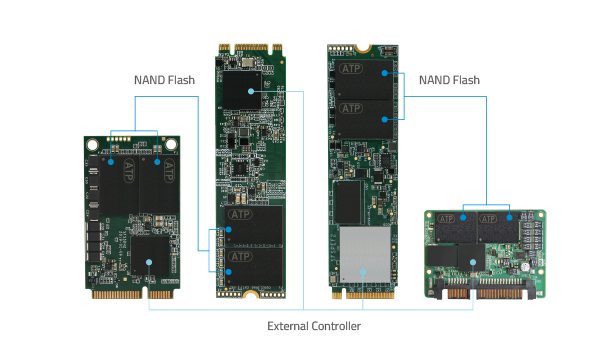
Raw NAND Flash Memory. This type of NAND flash requires an external hardware controller to handle the flash management functions, such as bad block management, wear leveling, error correction, logical-to-physical address translation, garbage collection, and other functions. ATP offers a full range of SSD modules with raw NAND flash memory in different form factors and capacities.
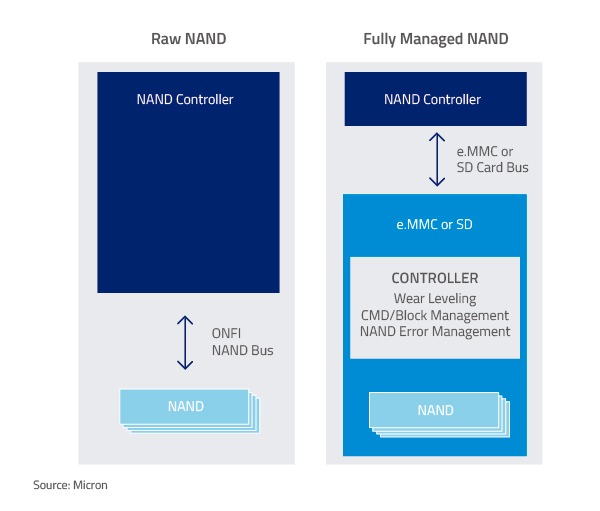
Managed NAND Flash Memory. This type of memory combines raw NAND and a sophisticated hardware controller within the same package, allowing memory management to be done internally. Because all components are integrated in one package, the internal controller handles all the NAND flash management, freeing the host from having to do wear leveling, bad block management, error correction, and other background functions. Managed NAND memory is designed to deliver fast performance while consuming lower power. Due to the integrated design, they are available in very small form factors. The most popular forms of managed NAND are flash memory cards. The table below lists other examples of managed NAND flash memory.
| Managed NAND Type | Description |
|---|---|
| Embedded MultiMedia Controller (e.MMC) | e.MMC integrates the MultiMedia interface, flash memory, and a flash memory controller in the same IC package. It is offered in an industry-standard ball grid array (BGA) package. An e.MMC drive is just about the size of a postage stamp, making it an excellent solution for mobile and space-constrained systems. |
| Embedded USB (eUSB) | An embedded USB (eUSB) is a managed NAND flash solution that complies with USB standards. By using a widely adopted interface, eUSB can be used across different operating systems for a low cost, efficient data transfer solution. Typically used as an operating system boot device or main storage device, an eUSB drive should be recognized as a fixed drive. It is attached to the system board through a 10-pin (2x5) USB female connector along with a mounting hole to ensure stable connection. |
| Universal Flash Memory Storage (UFS) | UFS is available in multiple BGA form factors designed with the intention to be soldered to the printed circuit board. It is touted to deliver substantial performance improvements over today’s microSD cards, adopting the SCSI (Small Computer System Interface) high-speed serial interface protocol to deliver simultaneous read/write operations over two data lanes at high bandwidths. |
Flash Forward
Determining what kind of flash storage to use is a critical decision that could impact operations and return on investment (ROI). Storage designed for a single consumer will perform very differently from storage designed for rugged, demanding and mission-critical applications and thousands of users. What may seem less costly may actually be more expensive in the long run, so it is important to get the right SSDs that match your workload as well as your budget to get the most out of your investment.
ATP’s wide range of industrial SSDs is designed for long, reliable performance under heavy workloads and even in the harshest and most demanding environments. As a true manufacturer, ATP manages the stages of the manufacturing process and conducts thorough testing from wafer/IC level to module and product level to ensure that only products of the highest quality are produced from its facilities.
Conclusion
Consumer and industrial SSDs can look alike on a spec sheet, but they are built for different worlds — the difference shows up in temperature range, write endurance, power-loss protection, and long-term supply stability. Match the drive to the workload: a consumer SSD where the environment is benign and a failed unit is easy to replace, an industrial SSD wherever temperature, write volume, power stability, or uptime is on the line. For more information on ATP’s industrial NAND flash storage products, or for help matching a drive to your deployment, visit the ATP website or contact an ATP Distributor/Representative in your area.
Frequently Asked Questions (FAQ)
Q1: Why do consumer SSDs fail in industrial environments?
A: Consumer SSDs fail in industrial environments for four main reasons: they are rated only 0°C to 70°C and cannot handle the −40°C to 85°C extremes of industrial equipment; their low write endurance wears out under continuous heavy workloads; they lack power-loss protection, so an abrupt power cut during a write can corrupt data; and their components change frequently, breaking the long-term qualification an industrial system depends on. Industrial SSDs are engineered against all four with wide-temperature support, higher-endurance NAND, power-loss protection, and a fixed bill of materials.
Q2: How does storage latency affect industrial automation response times?
A: In most automation, storage latency does not directly drive control-loop response — PLC cycles run in milliseconds, motion-control cycles often faster, while SSD I/O typically completes in microseconds, so the drive is rarely in the real-time critical path. Storage latency matters most for data logging, event capture, recipe loads, and boot or crash recovery, and above all for latency consistency: a consumer SSD can stall for milliseconds when background garbage collection runs, and that unpredictable spike — not the average speed — sets the timing risk. Industrial SSDs are tuned for sustained, predictable latency under 24/7 load.
Q3: What is the difference between latency and bandwidth in an SSD?
A: Latency is the delay between issuing a single I/O request and its completion; bandwidth (throughput) is how much data the drive moves per second once transfers are in flight. Automation that issues many small, time-sensitive operations is sensitive to latency and its consistency, while bulk data capture or imaging is more sensitive to bandwidth. Both can look good in a short benchmark burst and degrade under sustained load, which is why industrial SSDs are specified for sustained, not just peak, performance.
Q4: Do I always need an industrial SSD, or is a consumer SSD ever enough?
A: Not always. A consumer SSD can be adequate when the drive stays within the 0°C to 70°C commercial range, the workload writes little data, power is protected at the system level, and a failed unit is easy to reach and replace. The case for an industrial SSD becomes compelling the moment any one of those no longer holds — uncontrolled temperature, heavy continuous writes, unstable power, or a remote, hard-to-service, or mission-critical deployment.
Q5: How long does an industrial SSD last compared with a consumer SSD?
A: An industrial SSD lasts far longer under heavy write workloads because it uses higher-endurance NAND and advanced wear leveling, giving it many more program/erase (P/E) cycles and a higher Terabytes Written (TBW) rating than a consumer TLC drive. ATP’s current 3D TLC industrial SSDs are rated 11,000 P/E cycles in native TLC mode and 100,000 P/E cycles in pSLC mode, versus roughly 1,000 to 3,000 for a typical consumer TLC drive. To estimate real service life, divide the drive’s rated TBW by how much your system writes per day — a drive rated for tens of thousands of TBW writing 100 GB a day will outlast the equipment around it.