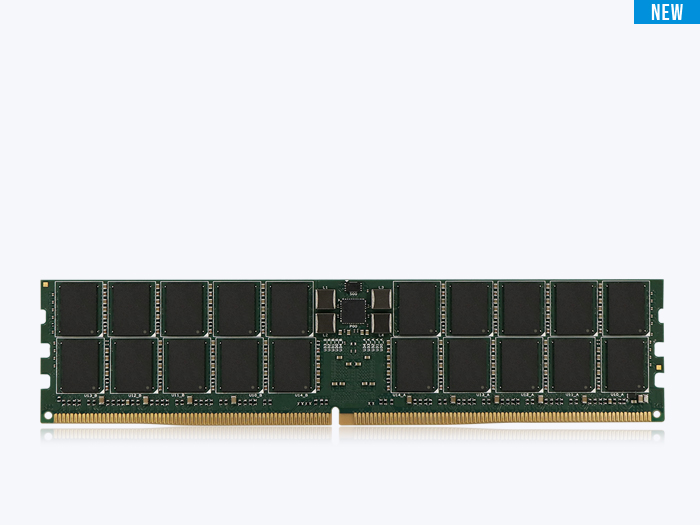
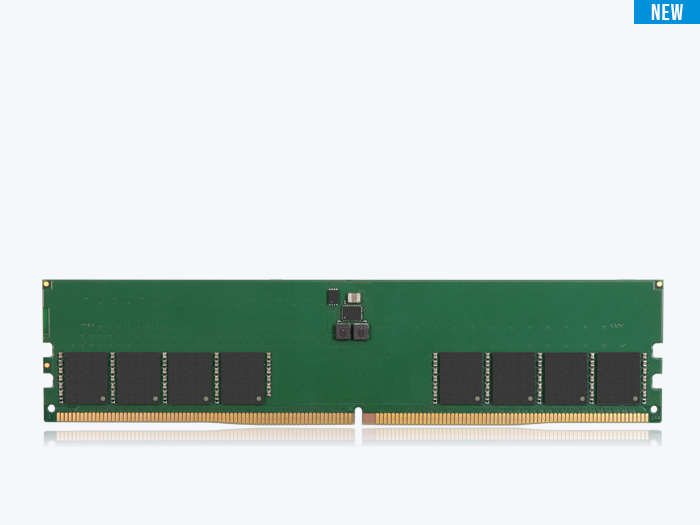
A memory rank is an electrical group of DRAM chips that together fill the system’s full data bus — 64 bits, or 72/80 bits with ECC. A single-rank (1R) module has one such group; a dual-rank (2R) module has two, which roughly doubles capacity at the same width. Rank is not a speed grade or a quality tier.
Key Takeaways
- A memory rank is an electrical grouping of DRAM chips that together fill the system’s full data-bus width. That is 64 bits for standard memory, or 72/80 bits for ECC memory.
- A single-rank (1R) module has one group of chips; a dual-rank (2R) module has two independent groups. A 1Rx8 module uses eight 8-bit chips; a 2Rx8 module uses sixteen, in two ranks of eight.
- Both ranks share the same data bus, so only one transmits at a time. The memory controller uses a separate Chip Select (CS) signal per rank to activate one while the other idles or precharges.
- Dual rank typically doubles capacity at the same width and can improve parallelism. The cost is extra electrical load on the bus, which can slightly limit the top speed at high frequencies.
Rank is not a speed grade
“Rank” is a frequently misread term on a memory label. It is not a speed grade and not a quality tier — it describes how the chips on a module are grouped electrically. Understanding rank explains why a 2Rx8 module has twice the chips of a 1Rx8, how the controller keeps two ranks from colliding on a shared bus, and why rank shows up in server memory population rules.
What is a memory rank?
A rank is an electrical grouping of DRAM chips that work together as a single set to fill the system’s total data-bus width — typically 64 bits for standard memory, or 72/80 bits for ECC memory.
The key idea is “together as a single set.” A rank is whatever collection of chips it takes to present one full-width data word to the host at once. With x8 chips and a 64-bit bus, that set is eight chips.
Single rank vs dual rank
The difference between single-rank (1R) and dual-rank (2R) organizations is how many independent sets of chips the memory controller manages on one module.
- Single rank (1R): all the DRAM chips on the module form one set, accessed simultaneously to provide a full-width data word. A 1Rx8 module uses eight 8-bit chips to fill a 64-bit bus.
- Dual rank (2R): the module is divided electrically into two independent sets of chips. Each set is a rank with its own Chip Select. A 2Rx8 module typically uses sixteen chips — two ranks of eight.
Because a 2R module carries twice the chips at the same width, it generally holds twice the capacity of the equivalent 1R module — for example, a 1Rx8 16 GB module versus a 2Rx8 32 GB module built from the same chips.
How ranks share the data bus
In a single-rank module, one set of chips drives the 64 bits of the data bus. In a dual-rank module, two independent sets are wired in parallel onto that same 64-bit interface. They share the same DQ (data) lines to the CPU.
Because they share those wires, both ranks cannot send data at the same time. The memory controller resolves this with the Chip Select (CS) signal. Each rank has its own CS line. The controller activates one rank’s CS to “talk” to it while the other rank stays idle or performs internal operations such as precharging. Switching between ranks lets the controller overlap useful work — one rank can recover while the other is being accessed.
Single rank vs dual rank at a glance
The width does not change between 1R and 2R — both still present 64 bits to the bus. What changes is how many independent groups stand behind that bus, and therefore the capacity and the parallelism available to the controller. In ATP’s industrial and embedded modules, rank is also a signal-integrity and validation question: more ranks add electrical load, which is why a deployment platform usually fixes the rank count it will accept.
| Feature | Single Rank (1R) | Dual Rank (2R) |
|---|---|---|
| Bus width | 64 bits (or 72/80 with ECC) | 64 bits (or 72/80 with ECC) |
| Data paths | One set of DQ lines | One set of DQ lines (shared) |
| Chip selects | 1 CS signal per module | 2 CS signals per module |
| Capacity | Base (e.g., 16 GB) | Double (e.g., 32 GB) |
Table 1. Single rank versus dual rank at the same data width. The bus stays 64 bits; the second rank adds capacity and a second Chip Select, not extra width.
Frequently Asked Questions (FAQ)
Q1: What is a memory rank?
A: A memory rank is a set of DRAM chips that work together to fill the full data-bus width — 64 bits for standard memory, or 72/80 bits for ECC. The chips in a rank are accessed at the same time to present one complete data word to the system.
Q2: What is the difference between single rank and dual rank?
A: A single-rank module has one group of chips on the data bus; a dual-rank module has two independent groups sharing the same bus. Dual rank typically doubles capacity at the same width and uses a second Chip Select signal so the controller can address each rank separately.
Q3: Is dual-rank memory faster than single-rank?
A: Dual rank can improve performance through better bank-level parallelism, since the controller can work with one rank while the other recovers. The benefit is workload-dependent, and the extra electrical load can slightly cap the top clock speed at high frequencies.
Q4: How many chips are on a 2Rx8 module?
A: Typically sixteen DRAM chips — two ranks of eight 8-bit chips each. A 1Rx8 module, by contrast, has eight chips. ECC versions add chips per rank to carry the check bits.