e.MMC (Embedded MultiMediaCard) integrates NAND flash, controller, and MMC interface in a single soldered BGA package — the default storage architecture for space-constrained embedded industrial computers. This article explains how ATP’s industrial e.MMC protects data integrity, quality, and reliability, and when a design should choose e.MMC, step up to an SSD, or stay removable.
Key Takeaways
Storage architecture in an embedded industrial computer is a board-level design decision, not a spec-sheet line. The right choice follows from four constraints: board space, vibration exposure, capacity and bandwidth requirements, and how the system will be serviced.
- For space-constrained, vibration-exposed embedded systems at low-to-mid capacities, soldered-down e.MMC is the right starting point. ATP’s industrial e.MMC integrates the NAND flash, controller, and MMC interface in a single 153-ball FBGA measuring 11.5 × 13.0 × 1.2 mm, reflow-soldered to the board — no connector to work loose, no drive bay to design around.
- e.MMC is managed NAND: the controller inside the package handles wear leveling, data refresh, and the other low-level flash operations internally, freeing the host processor and simplifying the interface design — the reason e.MMC is a default for boot and application storage in embedded designs.
- Know the architecture’s ceiling before committing. JEDEC e.MMC 5.1’s HS400 mode provides up to 400 MB/s of bus bandwidth, and ATP’s current line spans 10 GB to 256 GB. A design that needs more capacity or sustained throughput should step up to a soldered PCIe NVMe BGA SSD or a modular M.2 SSD — same decision axes, different point on the curve.
- Data integrity across unattended years comes from controller firmware. AutoRefresh monitors error-bit levels and read counts and moves data to a healthy block before its read-count threshold is reached; Dynamic Data Refresh scans the user area in the background while the device is free from host commands; a configurable SRAM soft-error detector provides timely error detection and logging; and firmware-based power-loss protection safeguards data already committed to flash.
- Not every embedded computer needs the industrial part. ATP’s commercial-grade e.MMC (−25°C to 85°C) serves climate-controlled installations at lower cost; the industrial grade (−40°C to 85°C, screened with thermal-cycling Rapid Diagnostic Test) earns its premium where temperature, vibration, or unattended operation cannot be designed away. And where routine field replacement is part of the service plan, a removable card is the better architecture than any soldered device.
The ATP Industrial e.MMC Solution
The ATP industrial e.MMC (Embedded MultiMediaCard) solution is designed to meet the high-performance data transfer and storage requirements of industrial and embedded applications in space-constrained systems requiring rugged reliability and very high endurance.
Compliant with the latest JEDEC e.MMC v5.1 specifications, the ATP e.MMC is an embedded storage solution consisting of an MMC interface, flash memory and controller integrated in the same IC package and offered in a 153-ball fine pitch ball grid array (FBGA) package. The integrated package simplifies the application interface design, making the ATP e.MMC suitable for industrial applications requiring rugged endurance, reliability and durability in challenging operating environments.
While several module houses and manufacturers already have their own versions of industrial e.MMC, the ATP e.MMC is backed by over 25 years of ATP’s pioneering expertise in manufacturing flash memory and storage products.
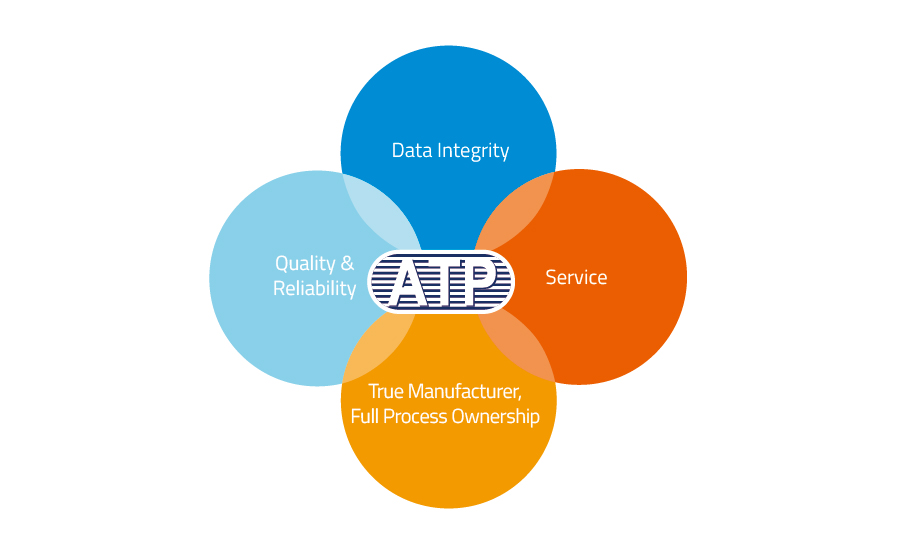
As shown in the figure below, ATP e.MMC’s strengths are not only about the product itself, but the ATP name that backs it up.
What Storage Architecture Is Best for Embedded Industrial Computers?
For most embedded industrial computers, the best storage architecture is soldered-down managed NAND — e.MMC — for boot and application storage at low-to-mid capacities, stepping up to a PCIe NVMe SSD only when capacity or bandwidth outgrows the e.MMC interface. The reasoning is the machine itself: an embedded industrial computer is defined by its constraints — a small board, a sealed or fanless enclosure, vibration, wide temperatures, and years of unattended service. Choosing the storage architecture means answering four questions in order: how much board space exists, whether the system vibrates, how much data must move and how fast, and who will service the unit once it is deployed.
e.MMC answers the first two questions better than any alternative. The entire storage subsystem — NAND flash, controller, and MMC interface — occupies one 153-ball FBGA of 11.5 × 13.0 × 1.2 mm, reflow-soldered to the board: there is no socket or connector to work loose under vibration, and no cable or bay to design around. Because it is managed NAND, the controller inside the package runs wear leveling, data refresh, and every other low-level flash operation internally, freeing the host from flash management and reducing the interface design to a single set of BGA pads. ATP’s industrial e.MMC carries this architecture across a −40°C to 85°C operating range with firmware-based power-loss protection for data at rest, and the smaller-footprint e.MMC line extends it to boards where even the standard package is generous. Within the architecture, one decision remains: ATP’s current line offers 3D TLC parts for capacity and pSLC-mode parts for write-intensive duty.
The same four questions can point away from e.MMC, and it is worth knowing where the boundary runs. The e.MMC 5.1 interface tops out at 400 MB/s of HS400 bus bandwidth, and ATP’s line reaches 256 GB — ample for boot images, application code, logging, and local databases, but not for sustained video analytics or large AI datasets. Designs beyond that line should keep the decision axes and change the component: ATP’s PCIe NVMe M.2 1620 HSBGA SSD keeps the soldered-BGA architecture while moving to the NVMe interface, and modular M.2 NVMe SSDs add capacity and serviceability where the enclosure allows. Where the maintenance plan calls for storage that field staff can swap without touching the board, a removable industrial SD or CFast card is the honest answer, not a soldered device. An architecture is only “best” when it matches the constraint set — which is why the answer starts with the four questions, not with a product.
Data Integrity
Data integrity refers to the reliability and accuracy of data over the entire usage life of the storage device. To ensure that there is no loss in data quality when using an ATP e.MMC device, it employs the following built-in technologies.
Configurable SRAM Soft Error Detector and Recovery Mechanism. Soft errors in the static random access memory (SRAM) corrupt memory bits and alter stored data or change instructions in a program. They do not cause physical damage to the memory or storage device, but will cause damage to the data.
Although usually remedied by a system cold boot, unattended SRAM soft errors can significantly jeopardize data accuracy, and the system may continue operating on corrupted data. These errors are of great concern especially in mission-critical applications, where high levels of data integrity and availability are required.
The ATP e.MMC features an advanced SRAM Soft Error Detector and Recovery mechanism, which maximizes data integrity by providing timely error detection, logging, and configurable* action to address the error. If, after assessing the risk, the user opts to continue running the device, an error log will be created and a system reboot should be performed to avoid unpredictable events that could damage the system, or worse, cause personal safety risks in critical autonomous applications.
* Note: The configuration setting is predetermined by the customer with ATP and is done before product shipment. Configuration cannot be changed in the field.
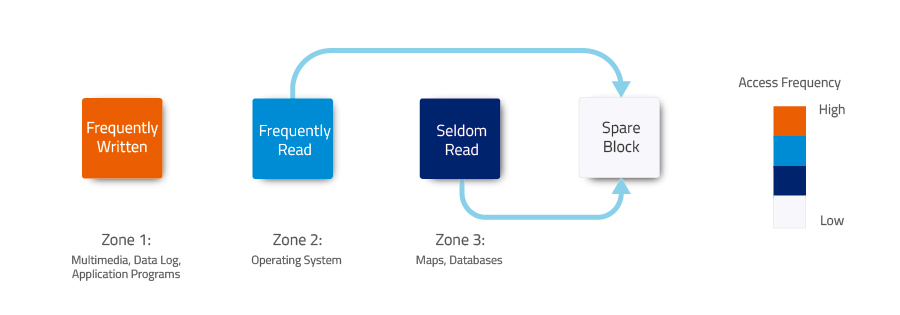
AutoRefresh Technology. Read disturb happens when frequent reading of a cell causes adjacent cells to change or be programmed. AutoRefresh Technology improves the data integrity of read-only areas by monitoring the error bit level and read counts in every read operation. It detects when the read count is about to exceed the threshold. Before the limit is reached, data in the affected block is copied to a healthy block, thus preventing the controller from reading blocks with too many error bits. With this technology, the ATP e.MMC performs reliably and prevents uncorrectable data damage.
Dynamic Data Refresh Technology sustains data integrity in seldom-accessed areas. Dynamic Data Refresh runs automatically in the background, sequentially scanning the user area flag record while the ATP e.MMC is free from host commands, thus keeping data safely stored without affecting the read/write operation.
Product Quality and Reliability
- Industry-Leading NAND Screening Capability. With over 25 years’ experience in the NAND flash product industry, ATP is thoroughly knowledgeable in NAND characterization. ATP believes that high-quality components are the building blocks to high-quality products and makes sure that screening begins at the integrated circuits (IC) level, where NAND flash is screened for temperature tolerance, data retention, disturbance, and other attributes.
- Extreme Endurance: 2-3X Higher than Standard e.MMC*. One reliable way of measuring flash storage endurance is by the number of write and erase operations, also called program/erase (P/E) cycles. At mass production stage, Rapid Diagnostic Test (RDT) is performed to screen out weak ICs for early life failure and to ensure long endurance with robust components. Stringent NAND flash sorting and screening during thermal cycling tests, functional tests, robust product design, and high-quality wafer packaging ensure high P/E cycles, healthy memory storage, and the long product service life of the ATP e.MMC.
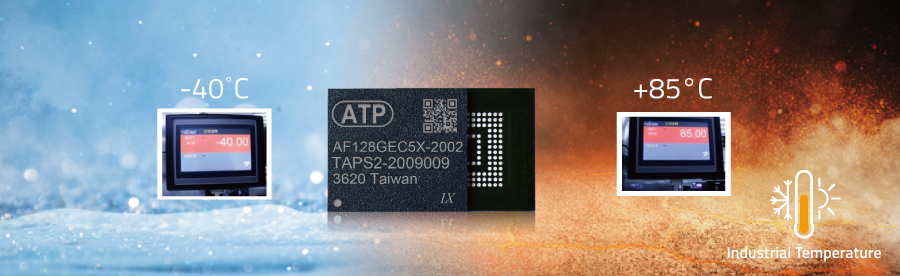
- Robust Durability. ATP e.MMC is available in industrial temperature-rated operating range, performing dependably in sub-freezing −40°C to searing 85°C. Sturdy and resilient, the ATP e.MMC can withstand harsh environments and extreme temperatures, as well as power and thermal cycling in demanding operation scenarios.
* May vary by product and project support.
ATP as a True Manufacturer: Full Process Ownership
ATP maintains complete control of all stages of the manufacturing process — from the time the wafers are received all the way up to the finished product. ATP performs in-house testing, quality control, Rapid Diagnostic Test (RDT) and in-house field application (FA). By taking charge and ownership of the processes, ATP also maintains control of its supply and value chains. We implement controlled bill of materials (BOM) with longevity planning and maintain buffer inventory to prevent stock outs.
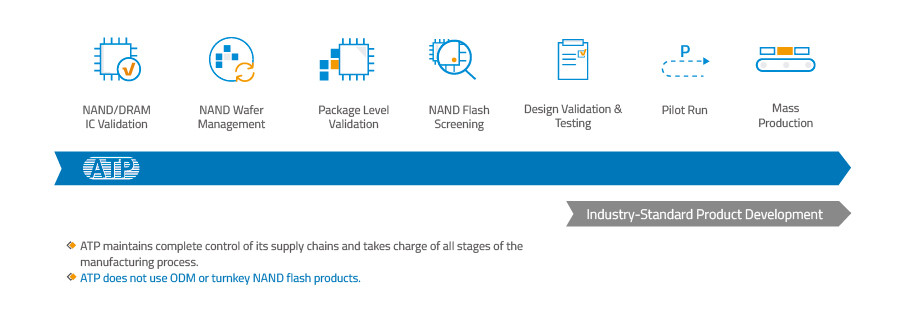
ATP-Owned Manufacturing Facilities. The ATP e.MMC is designed, produced and tested at ATP’s own purpose-built factory, using ATP-designed firmware and testing platforms.
Post-Manufacturing Process Excellence. Each ATP e.MMC is manufactured to stringent standards to meet the requirements of industrial applications, and further processes are applied after the product is finished. Below is the sequence every ATP e.MMC goes through before shipment.
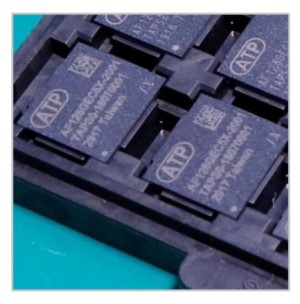
- Ensuring Product Traceability. Laser imprints important information to identify each piece for accurate tracking and efficient inventory management.
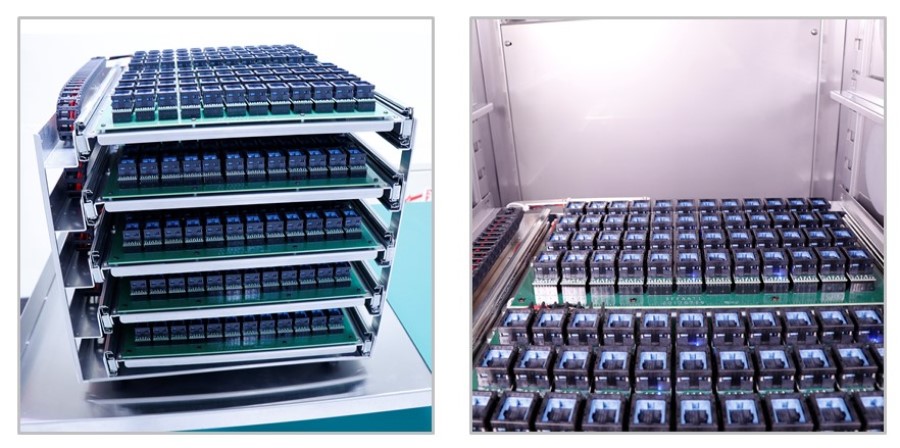
- Rapid Diagnostic Test (RDT). RDT is performed to evaluate product reliability under extreme temperatures and to catch early and latent defects. ATP e.MMC devices are loaded into a specially designed RDT chamber for thermal cycling tests at both low (−40°C) and high (85°C) temperatures. ATP can perform high-volume testing according to customer request.
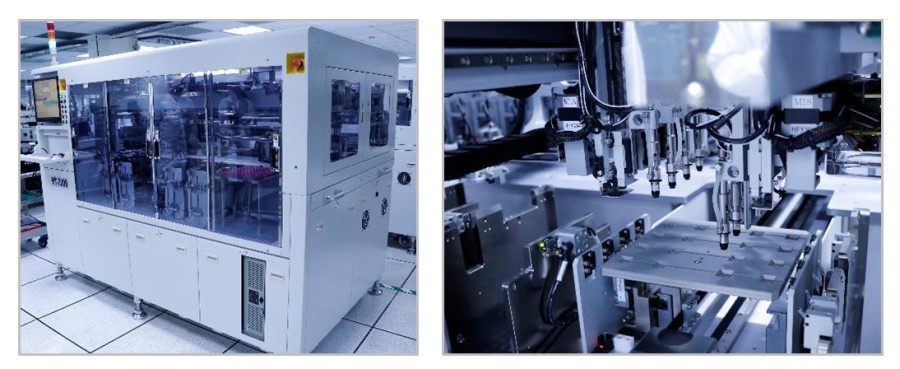
- Automated Final Screening. A special machine performs high-speed automated initialization and screening to make sure that errors and failed parts not caught during the production stage are effectively screened out before the product is packaged.
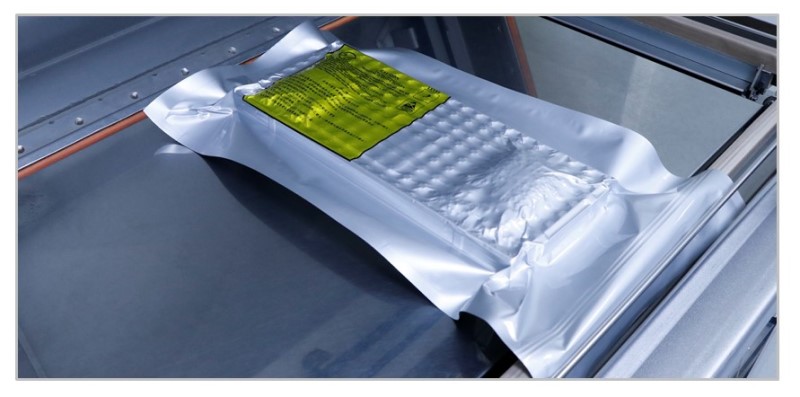
- Protective Packaging. Finally, the ATP e.MMC is vacuum-sealed, removing all the air from the packaging, including humidity and moisture that could cause corrosion. Vacuum packaging also safeguards the ATP e.MMC against environmental hazards that could cause damage while the devices are stored or in transit.
Service
Beyond manufacturing, ATP offers value-added services by project support and customer request, such as Joint Validation, where ATP conducts compatibility and function tests with client-supplied host devices and systems to proactively detect and minimize failures that may not have been caught in production tests. As of this article’s publication (2020), ATP also guarantees long product cycles with a longevity commitment of over 5 years for MLC NAND-based e.MMC.
Conclusion
Find out how the industrial e.MMC and other ATP flash memory and storage products can meet your diverse data storage requirements. Visit the ATP website or contact an ATP Representative/Distributor.
Frequently Asked Questions (FAQ)
Q1: What storage architecture is best for embedded industrial computers?
A: Soldered-down managed NAND — e.MMC — is the best starting architecture for most embedded industrial computers: it puts NAND flash, controller, and interface in a single BGA package that resists vibration, occupies minimal board space, and manages the flash internally so the host does not have to. The decision rests on four constraints: board space, vibration exposure, capacity and bandwidth needs, and the service model. e.MMC serves low-to-mid capacities — ATP’s line spans 10 GB to 256 GB at up to 400 MB/s of HS400 bus bandwidth — while designs needing more step up to a soldered PCIe NVMe BGA SSD or a modular M.2 SSD, and systems whose service plan requires field-swappable storage are better served by removable industrial SD or CFast cards.
Q2: What is e.MMC storage?
A: e.MMC (Embedded MultiMediaCard) is an embedded storage architecture that integrates NAND flash memory, a flash controller, and an MMC interface in a single BGA package soldered to the host board. Defined by the JEDEC e.MMC 5.1 standard (JESD84-B51), it is managed NAND: the built-in controller performs wear leveling, data refresh, error correction, and the other low-level flash operations internally, presenting the host with a simple block-storage device. The standard’s HS400 mode provides up to 400 MB/s of bus bandwidth. ATP’s industrial e.MMC comes in a 153-ball FBGA, operates from −40°C to 85°C, and is typically used for boot and application storage in industrial and embedded systems.
Q3: When should an embedded design use e.MMC instead of an M.2 SSD?
A: Use e.MMC when board space, vibration resistance, and design simplicity matter more than maximum throughput and capacity — typically boot, application, and logging storage up to 256 GB, where HS400’s 400 MB/s bus bandwidth is sufficient. An M.2 NVMe SSD is the right choice when the workload needs more sustained throughput or capacity than the e.MMC interface offers and the enclosure can accommodate a socketed module. Between the two sits the BGA SSD — ATP’s M.2 1620 HSBGA — which keeps e.MMC’s soldered, vibration-resistant architecture while moving to the PCIe NVMe interface. Endurance also steers the choice within the e.MMC line: current ATP parts are rated from 110 TB written on the smallest 3D TLC configurations up to 2,000 TB on the largest pSLC-mode configurations, so write-intensive duty points to pSLC trims before it forces a change of architecture.
Q4: Is soldered-down storage more reliable than removable storage in industrial systems?
A: Under vibration and shock, yes: a soldered BGA device such as e.MMC has no connector interface to fret, oxidize, or work loose, which is why it is preferred in transportation, machinery, and other high-vibration systems. But mechanical robustness is only one axis. A removable industrial SD or CFast card can be replaced or upgraded in the field in minutes without board rework, while a failed soldered device means board-level repair. The right choice follows the service model: solder the storage when the system must survive years of vibration without intervention; keep it removable when routine replacement or capacity upgrades are part of the maintenance plan.
Q5: How does industrial e.MMC keep data intact through years of unattended operation?
A: Through controller firmware that works on the data between host accesses. AutoRefresh monitors error-bit levels and read counts in every read operation and copies data from an affected block to a healthy one before the read count exceeds its threshold. Dynamic Data Refresh runs automatically in the background, sequentially scanning the user area while the device is free from host commands, keeping stored data intact without interrupting host reads and writes. A configurable SRAM soft-error detector provides timely detection and logging of soft errors in the controller’s SRAM, with the response configured with ATP before shipment. Firmware-based power-loss protection safeguards data already committed to flash through power interruptions; the write in flight at the instant power is cut is not guaranteed to complete, so continuous-write systems should still provide a clean shutdown at the system level.