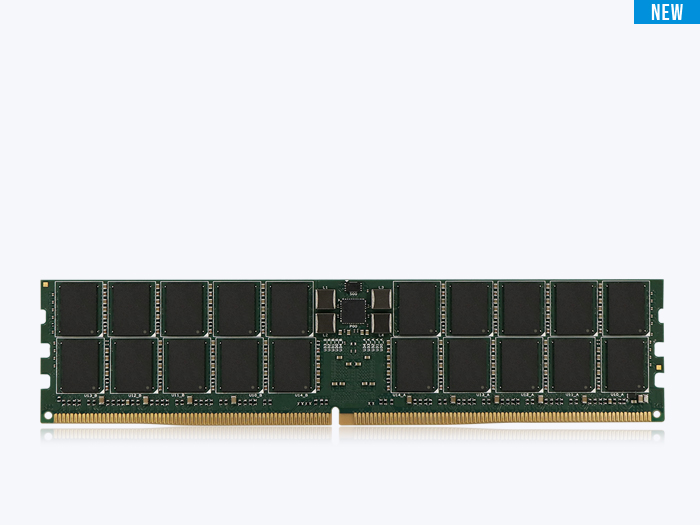
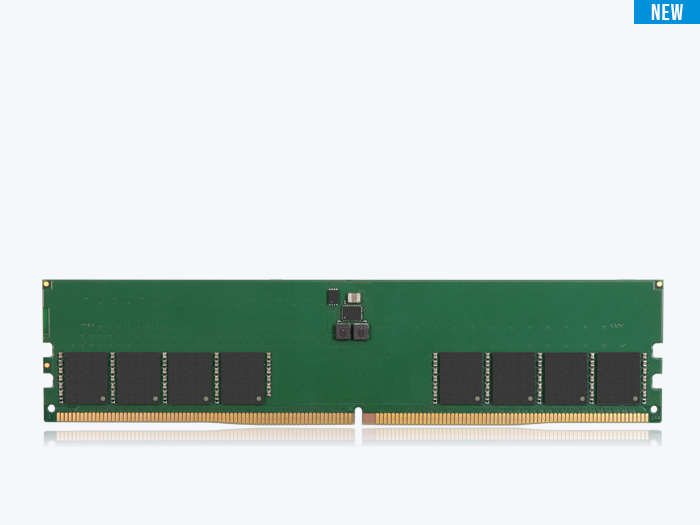
Can you mix DRAM configurations? On a single DIMM, no — the module is wired for one chip depth and width at manufacture. Across slots, mixing different modules is sometimes tolerated on consumer boards (usually by downclocking to the slowest module) and almost never advisable on servers, which require matching rank count and width across a channel.
Key Takeaways
- You cannot mix different chip depths or data widths on a single DIMM. The address bus, the data-trace routing, and the register on a buffered module are all wired for one configuration.
- A x16 chip will not work on a board designed for x8. A 1Rx8 PCB physically routes 8 data bits to each chip site, so a wider chip does not fit the electrical traces.
- Across slots, consumer boards may tolerate mixed modules — but at a cost. They typically downclock to the slowest common module or fail to boot, rather than running each module at its own speed.
- Server platforms are strict about geometry. Most require all DIMMs within a channel — and often across the whole processor — to share the same rank count and data width.
The short answer
A common question when expanding or repairing memory is whether you can combine parts: different chip widths on one module, or different modules in the same system. The short answer is that a single DIMM is fixed at manufacture and cannot be mixed, while mixing modules across slots is sometimes possible on consumer hardware and almost never advisable on servers. Here is why, mechanism by mechanism.
Can you mix configurations on one DIMM?
No. A DIMM is engineered around one chip configuration, and three separate constraints enforce that:
Address bus
The CPU’s memory controller sends address signals to every chip on a rank, and all chips on that rank share the same address bus. A chip with a 4G depth needs more address lines than a 2G-depth chip. If chips of different depths sat on the same rank, the controller would have no consistent way to map memory across them.
Data bus alignment
The x8 or x16 designation is how many data bits each chip handles, and the board is wired to match. A 1Rx8 PCB physically routes 8 bits of the data bus to each chip site. A x16 chip would not fit those traces — the electrical layout simply does not carry its 16 data lines.
The register (RCD)
On a registered DIMM (RDIMM), a Registering Clock Driver — the “R” — buffers the command and address signals before they reach the chips. It is programmed for a specific number of loads and a specific bit width. It cannot manage a hybrid layout of different chip architectures on the same module.
Can you mix different DIMMs across slots?
This is the more practical question, and the answer depends on the platform.
Consumer motherboards
Some modern consumer boards are flexible about pairing, say, a 1Rx8 module in one slot and a 1Rx16 module in another. But flexibility is not free performance: the system will usually downclock to the slowest common denominator, run in a less optimal interleaving mode, or in some cases fail to train and boot. It tolerates the mismatch rather than benefiting from it.
Servers (RDIMMs)
Strictly no, as a rule. Servers are extremely sensitive to memory geometry. Most server platforms require all DIMMs within a single channel — and often across the entire processor — to have the same rank count and bit width. A population of all-1Rx8 modules is a typical requirement, and validated memory lists exist precisely so that integrators do not have to guess.
Practical guidance for specifying memory
- Buy a matched set when populating a channel or a system, especially for servers and workstations.
- Match rank count and width across a channel; check the platform’s memory population rules and validated module list before mixing.
- Treat configuration, not just total gigabytes, as part of the spec — two modules can share a capacity yet differ in rank and width, which is what platforms actually check.
- When in doubt on an industrial or embedded build, validate the exact module against the target platform rather than assuming compatibility from the capacity label alone.
ATP validates DRAM modules against the platforms its customers deploy on, which is the surest way to avoid a geometry mismatch that only surfaces during memory training.
Frequently Asked Questions (FAQ)
Q1: Can you mix x8 and x16 chips on the same memory module?
A: No. A DIMM is wired for one configuration — its address bus, data-trace routing, and register all assume a single chip depth and width. Different chips cannot be combined on one module.
Q2: Can I mix 1Rx8 and 1Rx16 DIMMs in the same computer?
A: On some consumer motherboards you can, but the system usually downclocks to the slowest common module or fails to boot. On servers it is generally not allowed, because the platform requires matching rank count and width across a channel.
Q3: Why are servers so strict about mixing memory?
A: Servers run memory at high speeds with tight signal-integrity margins and rely on consistent geometry for training and interleaving. Most platforms require identical rank count and bit width across a channel, and often across the whole processor, to remain stable.
Q4: Does mixing memory modules damage anything?
A: It generally will not damage hardware, but it can prevent the system from booting, force a lower clock speed, or disable performance features like dual-channel interleaving. The risk is instability and lost performance, not physical harm.