Server systems running non-stop typically use registered dual in-line memory modules (RDIMMs) to meet the rigors of compute-intensive, 24/7 operations. This article explains what RDIMMs are, why the registered clock driver (RCD) is a critical component, and why wide-temperature modules validated for continuous operation are increasingly a necessity at the edge.
Key Takeaways
- Industrial systems require DRAM validated for 24/7 operation because they run continuously and unattended: a module that was only spot-tested at room temperature has never been proven under the sustained thermal and electrical stress it will actually face. ATP’s wide-temperature RDIMMs are 100% module-level tested across the full −40°C to 85°C range.
- A module is only as robust as its weakest component. Even with wide-temperature DRAM ICs, a commercial-grade RCD rated 0°C to 85°C caps the entire module at 0°C. An industrial-temperature RCD rated −40°C to 85°C removes that cap.
- Continuous operation exposes failures that short tests miss. Sustained heat accelerates charge leakage in DRAM cells and erodes timing margins, so burn-in stress testing (TDBI) is what screens out the marginal chips that pass a brief room-temperature test but fail in the field.
- Not every system needs this. If the module sits in a climate-controlled enclosure that stays within 0°C to 85°C and is easy to reach and replace, a commercial-grade RDIMM is adequate and costs less.
Why RCDs Are Critical Components of RDIMMs
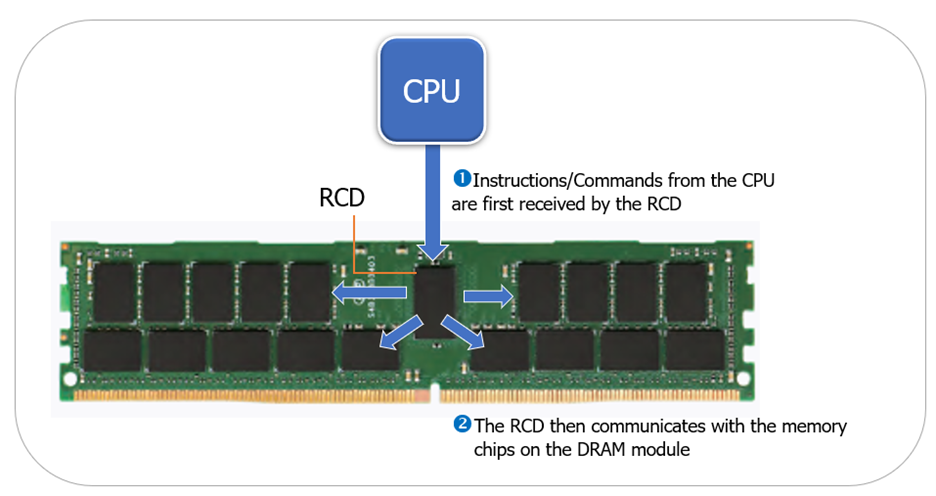
A registered clock driver (RCD) chip, also simply known as a “register,” is a critical component of RDIMMs. The RCD receives the command, address, and clock signals from the CPU’s memory controller, holds them for one clock cycle, and re-drives them to the DRAM chips on the module on the next clock edge. This buffering adds roughly one clock cycle of latency, but it reduces the electrical load on the memory controller and preserves signal integrity. Data signals are not buffered by the RCD — they move directly between the memory controller and the DRAM chips.
By buffering the command, address, and clock signals, the RCD reduces the electrical load each module places on the memory bus. This lets a channel support more, denser modules at rated speed — which is why enterprise and server platforms, in contrast to speed-driven applications like gaming, rely on registered DDR4 modules for sustained performance at high capacity.
The figure below illustrates how the CPU communicates first with the RCD on each module, which in turn communicates with the memory chips on the dynamic random access memory (DRAM) module.
ATP’s Wide-Temp RDIMMs with I-Temp RCD: Ensuring Reliability in Extreme Cold and Heat
It is not uncommon for DRAM modules to be installed in systems that operate in harsh environments and extreme temperatures that fluctuate between daytime and nighttime, as well as in varying weather conditions.
From land to sea, aerospace, and even outer space, applications in demanding computing environments require rugged, reliable, and enduring memory. For such demands, regular commercial-grade DRAM modules rated to support temperatures from 0°C to 85°C may not be up to the challenges. When these memory modules fail, the time, labor, and cost required to replace them in remote locations can disrupt operations and adversely affect the business.
As edge computing for the Industrial Internet of Things (IIoT), Artificial Intelligence of Things (AIoT), and 5G Open Radio Access Network/Distributed Unit (O-RAN/DU) becomes more universal, memory with a broader range of temperature capabilities is becoming more necessary than ever.
ATP recognizes that most edge computing applications run 24/7, often in challenging environments. To offer better reliability and durability in critical environments where commercial-grade DRAM modules do not suffice, ATP offers DDR4 wide-temp RDIMMs with an industrial-temperature-rated RCD.
The following table compares commercial-grade RDIMMs with wide-temperature RDIMMs with I-Temp RCD, which offer stability and reliability even in sub-zero temperatures.
| Dimension | Commercial-Grade RDIMM | Wide-Temperature RDIMM |
|---|---|---|
| DRAM IC | Commercial-grade IC (0°C to 85°C) |
Wide-temperature IC¹ (−40°C to 85°C) |
| RCD IC temperature rating | Commercial grade (0°C to 85°C) |
Industrial grade (−40°C to 85°C) |
| Module operating temperature | 0°C to 85°C | −40°C to 85°C |
| Testing features | ATE² & TDBI³ Module-level test (room temperature) |
ATE² & TDBI³ 100% module-level test (−40°C to 85°C) |
1. Wide-temperature ICs reach the industrial temperature range at lower cost through enhanced screening and more rigorous testing.
2. ATE: Automated Test Equipment
3. TDBI: Test During Burn-In
Why Do Industrial Systems Require DRAM Validated for 24/7 Operation?
Industrial systems require DRAM validated for 24/7 operation because they run continuously, unattended, and often in locations where a failed module means a site visit rather than a quick swap. Validation for 24/7 operation means every shipped module has been tested as a complete module — DRAM ICs, RCD, and PCB assembly together — across its full rated temperature range and under prolonged stress, not sampled briefly at room temperature.
Continuous operation changes what reliability testing has to prove:
- There is no recovery window. A system that never idles holds its memory at sustained operating temperature. Heat accelerates charge leakage in DRAM cells and erodes timing margins, so devices with marginal timing budgets begin producing intermittent errors that appear only under prolonged thermal load — the kind a short room-temperature test cannot surface.
- Module-level odds are worse than chip-level odds. An RDIMM carries multiple DRAM ICs plus an RCD, so even a very small marginal-failure rate per chip compounds into a meaningfully higher failure rate at module level. This is why ATP screens with test during burn-in (TDBI), which combines temperature, voltage, power cycling, and load over time to expose weak chips before assembly ships.
- The weakest component sets the module’s rating. The RCD receives and re-drives command, address, and clock signals for every operation, so it endures the same environment as the DRAM ICs. Pairing wide-temperature DRAM with a commercial-grade RCD rated 0°C to 85°C would leave the whole module unable to start below freezing — which is why ATP’s wide-temperature RDIMMs use an industrial-temperature RCD rated −40°C to 85°C.
- The cost of failure is asymmetric. In a 5G O-RAN roadside cabinet or a factory-floor controller, replacing one failed module carries travel, labor, and downtime costs that dwarf the price difference between memory grades.
| What 24/7 Validation Adds | Commercial-Grade RDIMM | ATP Wide-Temperature RDIMM |
|---|---|---|
| DRAM IC | Commercial grade | Wide-temperature screened IC, −40°C to 85°C |
| RCD temperature rating | 0°C to 85°C | Industrial grade, −40°C to 85°C |
| Module operating temperature | 0°C to 85°C | −40°C to 85°C |
| Module-level testing | ATE and TDBI, tested at room temperature | ATE and TDBI, 100% module-level tested across −40°C to 85°C |
The honest boundary: 24/7 validation earns its premium where the system is remote, the enclosure temperature is uncontrolled, or downtime is unacceptable. A server in a climate-controlled room with scheduled maintenance and staff on site is well served by commercial-grade RDIMMs — the environment those modules are rated and tested for.
ATP Reliability Testing
Like all ATP DRAM modules, ATP’s wide-temp DDR4 modules with I-Temp RCD undergo rigorous 100% module-level testing to ensure maximum reliability.
- Functional Testing Using Automated Test Equipment (ATE). The ATE detects component defects and structural defects related to the DIMM assembly and screens out marginal timing and signal integrity (SI) sensitivities. ATE provides electrical testing patterns with various parameter settings, such as marginal voltage, signal frequency, clock, command timing, and data timing under continuous thermal cycling. The ATE testing system can pinpoint individual defective ICs or DRAM PC boards, providing a more efficient failure analysis method for both new product development and mass production stages.
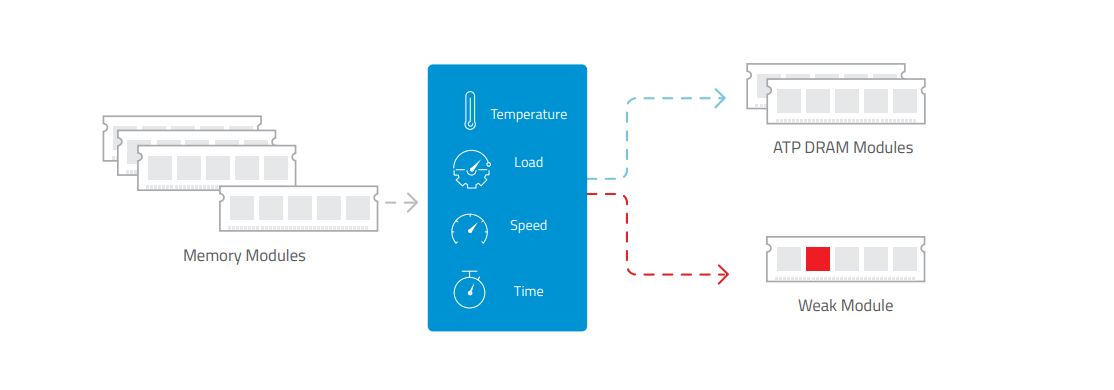
- System-Level Failure Detection and Prevention via TDBI. A module carries multiple DRAM ICs, so even a 0.01% marginal-failure rate per chip compounds into a meaningfully higher failure rate at module level. Test during burn-in (TDBI) screens out these marginal chips before shipment, lowering field failure rates and extending service life by making sure that only robust DRAM chips are on the module. TDBI testing may be tailor-fitted according to customer criteria, using various temperatures, power cycling, voltages, and other stress conditions within specified periods of time.
Key Specifications
| Feature | Description |
|---|---|
| Form factor | Wide-Temperature Registered ECC DDR4 DIMM |
| Key differentiator | Industrial-Temperature Registered Clock Driver (RCD) |
| Operating environment temperature | Ta: −40°C to 85°C Tc: −40°C to 95°C |
| Densities and configurations | See the current specification table on the ATP DDR4 product page. |
(Ta = Ambient Temperature; Tc = Case Temperature)
Conclusion
The increasing adoption of IIoT, AIoT, and 5G O-RAN/DU has been giving rise to more memory-intensive applications, many of which are expected to run 24/7 in harsh conditions such as extreme temperatures. Commercial-grade DDR4 RDIMMs may not be up to the task, and using them in rigorous scenarios may mean greater expenses in terms of operational disruptions and difficult, time-consuming replacements.
ATP’s wide-temperature DDR4 RDIMMs with I-Temp RCDs are built for applications requiring dependable, consistent, and enduring performance in extremely low and extremely high temperatures. Backed by over 30 years of manufacturing expertise and 100% module-level reliability testing, these rugged memory modules are built to withstand the most unforgiving environments. For DDR5 platforms, ATP offers wide-temperature-operable DDR5 modules.
For more information on ATP’s wide-temperature DDR4 RDIMMs with I-Temp RCDs, visit the ATP website or contact an ATP Representative.
Frequently Asked Questions (FAQ)
Q1: Why do industrial systems require DRAM validated for 24/7 operation?
A: Because industrial systems run continuously without operators nearby, a memory failure surfaces as unplanned downtime and a costly site visit rather than a quick reboot. DRAM validated for 24/7 operation is 100% tested at module level across its full rated temperature range — for ATP wide-temperature RDIMMs, −40°C to 85°C — using automated test equipment (ATE) and test during burn-in (TDBI), which screen out the marginal chips that pass a brief room-temperature test but fail under sustained thermal and electrical load. Commercial-grade modules are module-tested at room temperature, which is sufficient only for environments that stay within their 0°C to 85°C rating.
Q2: What is a registered clock driver (RCD)?
A: A registered clock driver (RCD) is a chip on a registered DIMM (RDIMM) that receives command, address, and clock signals from the CPU’s memory controller, holds them for one clock cycle, and re-drives them to the DRAM chips on the module. This buffering adds roughly one clock cycle of latency, but it reduces the electrical load on the memory controller and preserves signal integrity, allowing a memory channel to support higher densities at rated speed. The RCD handles only command, address, and clock signals — data moves directly between the memory controller and the DRAM chips.
Q3: Why does the RCD’s temperature rating matter as much as the DRAM’s?
A: Because a module can only be rated for the range every component on it survives. The RCD sits in the path of every command the module executes, so if wide-temperature DRAM ICs rated −40°C to 85°C are paired with a commercial-grade RCD rated 0°C to 85°C, the module as a whole is limited to 0°C — it cannot be trusted to cold-start in a sub-zero outdoor cabinet. ATP’s wide-temperature RDIMMs pair wide-temperature DRAM with an industrial-temperature RCD rated −40°C to 85°C, so the full module carries the −40°C to 85°C rating.
Q4: How is a wide-temperature RDIMM tested differently from a commercial-grade one?
A: Both grades pass functional testing on automated test equipment (ATE) and stress screening via test during burn-in (TDBI), but commercial-grade modules are module-tested at room temperature, while ATP wide-temperature RDIMMs are 100% module-level tested across the full −40°C to 85°C range. ATE screens marginal voltage, timing, and signal-integrity behavior under continuous thermal cycling; TDBI applies temperature, voltage, power cycling, and load over extended periods to force out early-life failures before modules ship.
Q5: Do all industrial systems need wide-temperature RDIMMs with an I-Temp RCD?
A: No. If the system operates in a climate-controlled environment that reliably stays within 0°C to 85°C, is easy to access, and can tolerate a maintenance window, commercial-grade RDIMMs are adequate and cost less. Wide-temperature RDIMMs with an industrial-temperature RCD earn their cost where the deployment is remote or unattended, the enclosure temperature is uncontrolled — especially with sub-zero cold starts — or where downtime and truck rolls are unacceptable. See the ATP DDR4 product page for current wide-temperature options.
