Wide-temperature DRAM modules rated −40°C to 85°C prevent the bit errors, boot failures, and premature wear that extreme heat and cold inflict on 5G edge, fleet, and railway computing systems. This article explains how memory fails at temperature extremes, when commercial-grade DRAM is (and is not) enough, and how ATP’s enhanced module-level testing delivers industrial-range reliability at a friendlier cost.
Key Takeaways
- Heat causes DRAM to fail in a predictable chain: as temperature rises, memory cells leak charge faster and data-retention margins shrink, producing bit errors, ECC events, and system crashes. Higher temperatures also force more frequent refresh — cutting effective bandwidth and raising power draw exactly when the system is hottest.
- Cold is as dangerous as heat. A railway or fleet computer parked overnight at sub-zero temperatures may fail to initialize at boot-up if its DRAM is not rated for cold start. Wide-temperature modules rated −40°C to 85°C cover both extremes.
- Wide-temp DRAM is the middle path on cost. It delivers the full −40°C to 85°C industrial range through IC screening and enhanced module-level testing, at a lower cost than modules built on native industrial-grade ICs.
- You may not need wide-temp everywhere. If the enclosure reliably stays within the commercial 0°C to 85°C window and a failed module is easy to reach and replace, commercial-grade DRAM can be adequate. Wide-temp earns its cost where temperature is uncontrolled, sites are remote, or downtime is unacceptable.
Why Extreme Temperatures Threaten System Memory
Whether your systems are installed or deployed in cities or remote locations, constant operation, heavy workloads, space constraints, and rugged environments can pose thermal challenges. Extreme heat or extreme cold can damage components and cause systems to fail, thus leading to breakdowns and costly disruptions.
Memory plays a critical role in any computing system, especially for those that require high reliability and availability while operating under rapid thermal cycling. Such applications require industrial-grade memory modules made with native industrial-grade integrated circuits (ICs) that are rated to operate at the industrial temperature range of −40°C to 85°C.
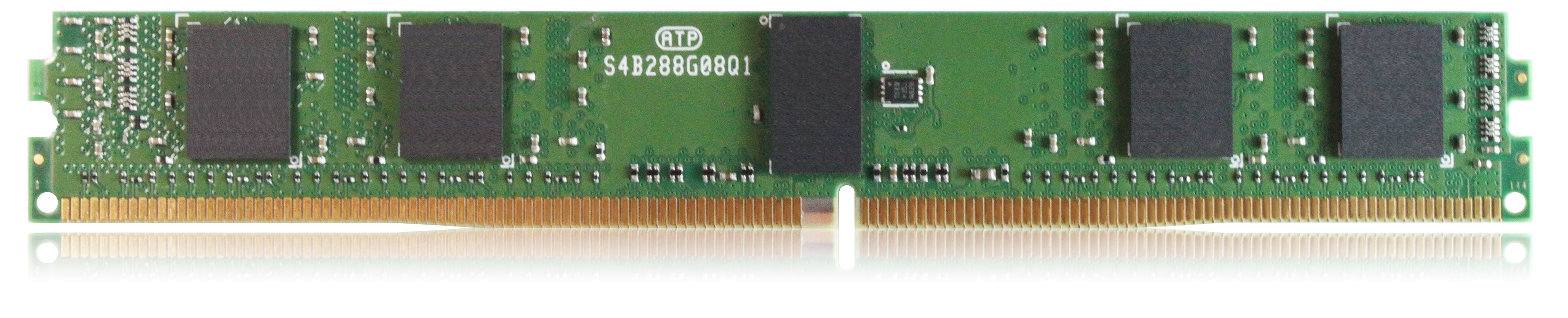
Extreme Temperature Environments
Applications that typically process huge amounts of data at high speeds encounter heat issues due to their workloads and the environments where they are deployed.
5G DU/CU/MEC and Networking Servers

A 5G Open Radio Access Network (O-RAN) architecture consists of functional components that connect users to the mobile network over radio waves, including distributed unit (DU), centralized unit (CU), and mobile edge computing platform (MEC) servers that require high reliability and low latency. Servers face constant thermal challenges due to numerous and high-performance components packed in a compact chassis.
Challenges:
- They run on Intel® Xeon® or AMD central processing units with high core counts. With higher computational power, they also consume more power and generate more heat, especially under heavy workloads, if air flow is insufficient, and if internal cooling is inefficient.
- As more components share the limited space within the chassis, there is less air flow within DIMMs.
- They are often installed in confined, enclosed spaces without air conditioning, where heat accumulates; outdoor deployments may additionally face high humidity.
- Even with air conditioning, the server cabinet may still have elevated temperatures.
Bus/Truck/Fleet/Public Transportation Gateways

Digital advances are driving today’s business transporters and public transportation systems, enabling connected monitoring and management. Passenger and driver experiences are also being enhanced with the delivery of greater comfort, safety, and infotainment by staying connected while on the move. In-vehicle gateways provide high-speed connectivity and real-time data processing to and from various transportation networks as well as functional domains within the vehicle. With more modern business and public transporters using electrical features, gateways enable more efficient in-vehicle control, asset/fleet monitoring, driver behavior monitoring, and offer connectivity to various hardware devices and other subsystems within the vehicle.
Challenges:
- Increasing vehicle electrification is also leading to increasing thermal challenges, as high power consumption leads to higher heat flow and component temperature.
- Vehicles traversing areas with shifting climates and extreme temperatures need operational reliability to ensure passenger comfort and safety.
Railway Computers

Smart railway infrastructures incorporate high-performance computer systems for passenger information, entertainment, railway controls and management, video surveillance, and other function-critical applications.
Challenges:
- Constant operation requiring reliable performance even in harsh environments.
- Component overheating within the chassis.
- Rail track temperatures in extreme conditions. When a train parks at the yard during non-service hours at freezing temperatures, upon resuming operations, DRAM without wide-temp support may fail to initialize at boot-up.
- At the cold extreme, condensation introduces short-circuit and corrosion risks and materials become brittle; sustained heat accelerates component degradation and can trigger thermal shutdowns — putting the train out of service and causing delays.
Other Industries Requiring Wide-Temp Solutions
Aside from the above-mentioned industries, other industries that may experience extreme temperatures and harsh environments that could prove detrimental to DRAM modules include aerospace, agriculture, telecom, and more. These applications typically require wide-temp solutions as systems are installed in waterproof, fanless enclosures and operate in environments with limited ventilation.
What Memory Failures Occur in High-Temperature Industrial Environments?
In high-temperature industrial environments, DRAM fails through five mechanisms: data-retention loss, refresh overhead, timing drift, accelerated aging, and thermal-cycling stress. Each one maps to a stress that module-level testing must reproduce before shipment.
- Data-retention loss and bit errors. DRAM stores each bit as charge in a microscopic capacitor that leaks continuously and must be refreshed. Heat accelerates that leakage, so marginal cells lose their data between refresh cycles, surfacing as single-bit errors, ECC corrections, or outright crashes.
- Refresh overhead at elevated temperature. To compensate for faster leakage, DRAM must refresh more frequently at high temperatures. More refresh cycles mean less bandwidth available to the host and higher power draw — a performance tax applied precisely when the system is already thermally stressed.
- Timing and signal-integrity drift. Temperature shifts the electrical behavior of memory ICs. Devices with marginal timing budgets begin producing intermittent errors that appear only under thermal load — the hardest failures to reproduce in the field.
- Accelerated aging. Sustained high temperature speeds up wear-out in silicon and interconnects, shortening the service life of modules that pass every test at room temperature.
- Thermal-cycling mechanical stress. Repeated hot-cold swings fatigue solder joints and can cause intermittent contact failures; at the cold extreme, condensation introduces corrosion and short-circuit risk.
These are exactly the failure classes ATP’s enhanced module-level TDBI is built to expose before a module ships: combined temperature, voltage, and pattern stress applied across the full −40°C to 85°C range. For a closer look at the methodology, see how ATP tests DRAM modules.
Is Commercial-Grade Memory Suitable?
While industrial-grade DRAM modules are the preferred memory solutions for systems deployed in harsh environments with extreme temperature shifts, they could be very expensive; hence, many companies resort to using commercial-grade DRAM, which are not suitable and may even prove more detrimental in the long run.
Aside from the actual cost of the modules, technicians may have to travel to remote sites to replace the modules, and operations must halt while awaiting replacement. These all translate to huge losses.
ATP Wide-Temp Solutions vs. Other Industrial Temp DRAM
ATP Electronics understands that businesses need to optimize ownership and operational costs and have come up with the ideal solution: wide-temperature DRAM modules that can operate reliably at −40°C to 85°C, but at lower costs. Through rigorous testing, ATP is able to offer wide-temp DRAM modules that achieve the best balance between optimal total cost of ownership (TCO) and long-term reliability.
Compared with other WT DRAMs in the market, ATP validates its wide-temp modules with exclusive IC-level screening and enhanced module-level TDBI applied across the full −40°C to 85°C range, using a miniature thermal chamber that isolates temperature stress to the module under test.
| Dimension | Commercial-Grade Modules | Wide-Temperature Modules | Industrial-Grade Modules |
|---|---|---|---|
| Target Market | General DRAM product | Price issue with industrial-grade solution | Customer specified |
| DRAM IC | Major IC | Wide Temp IC | Native industrial-grade IC |
| Operating Temp | 0°C to 85°C | −40°C to 85°C | −40°C to 85°C |
| Testing Feature | ATE & module-level TDBI | ATE & module-level enhanced TDBI (−40°C to 85°C) |
ATE & module-level TDBI |
ATP Enhanced Module-Level Testing for Wide-Temp DRAM
ATP’s stringent testing for its WT DRAM solutions consists of enhanced module-level Test During Burn-In (TDBI) and Automatic Test Equipment (ATE). Even after IC-level testing, a small fraction of marginal devices — on the order of 0.01% — can escape to the module level, where a single weak chip is enough to cause failure in actual usage. ATP’s TDBI applies combined temperature, voltage, and test-pattern stress to detect and screen out these marginal parts before shipment, significantly lowering failure rates and extending product service life.
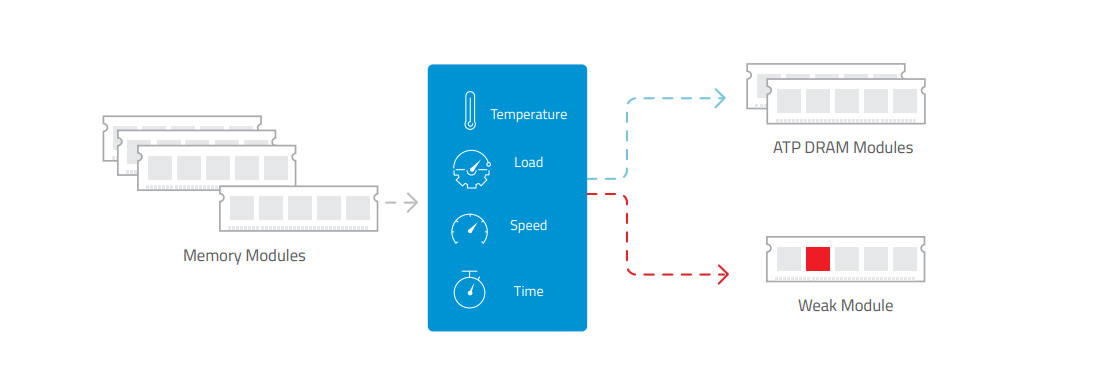
- Functional Testing Using Automatic Testing Equipment (ATE). The ATE detects component defects and structural defects related to the DIMM assembly and screens out marginal timing and signal integrity (SI) sensitivities. The ATE testing system can pinpoint individual defective ICs or DRAM PC boards, thus providing a more efficient failure analysis method for both new product development and mass production stages.
- System-Level Failure Detection and Prevention via TDBI. The ATP TDBI system applies extreme high/low temperature, high-low voltage, and pattern testing on DRAM modules. ATP TDBI combines temperature, load, speed, and time to stress test memory modules and expose weak modules before they ship.
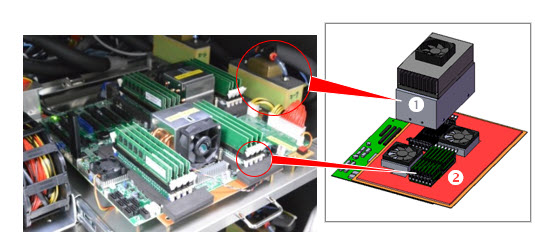
The TDBI system consists of:
- The miniature chamber, which isolates temperature cycling only to the module being tested so as not to thermally stress the rest of the testing system. This minimizes the failure of other testing components, such as the motherboards. In conventional large thermal chambers, the failures of non-DRAM-related testing components are constant given that the whole system is thermally stressed.
- Module riser adapters from the motherboard, which allow easy module insertions in production-level volumes.
Conclusion: Why You Need ATP’s Wide-Temp DRAM Solutions
In operating environments where temperatures could be extremely cold or hot, commercial-grade DRAM solutions may not be enough, and may even prove detrimental in the long run. On the other hand, DRAM modules that are I-Temp operable are ideal but are very expensive. To get the best balance between quality, reliability, and longevity at friendlier price points, ATP’s WT DRAM modules offer the optimal solution.
Below are some of the reasons why you need ATP’s WT DRAM solutions:
- Waterproof, no air conditioning, fanless environments.
- Even if there is air conditioning, wide-temp DRAMs have a longer life.
- Systems running non-stop 24/7 must not fail.
- The cost of replacing or fixing an appliance can be more than the cost of wide-temp DRAMs.
- For life-critical applications, human life may be at stake if the system fails.
- Systems run for over 10 years. ATP WT DRAMs offer fixed-BOM support for 5+ years.
For more information on ATP Wide-Temp DRAM modules, please visit the ATP website or contact an ATP Representative.
Frequently Asked Questions (FAQ)
Q1: What memory failures occur in high-temperature industrial environments?
A: High temperature causes five classes of DRAM failure: data-retention loss as memory cells leak charge faster and lose data between refresh cycles; refresh overhead that reduces bandwidth and raises power; timing and signal-integrity drift that produces intermittent errors under thermal load; accelerated aging that shortens module life; and thermal-cycling stress that fatigues solder joints. Industrial environments add cold-side risks too — boot failures and condensation at sub-zero temperatures.
Q2: What is wide-temperature DRAM?
A: Wide-temperature (WT) DRAM is a memory module built with ICs screened and stress-tested to operate reliably from −40°C to 85°C, delivering industrial-temperature capability at a lower cost than modules built on native industrial-grade ICs. ATP validates its wide-temp DDR4 modules with enhanced module-level TDBI — combined temperature, voltage, and pattern stress across the full rated range.
Q3: Do I need wide-temperature DRAM if my system is in a climate-controlled environment?
A: Often not for temperature alone. If the enclosure reliably stays within the commercial 0°C to 85°C window, commercial-grade DRAM can be adequate — the case for wide-temp then rests on margin and serviceability. Wide-temp modules run further from their rated limits, which extends service life, and they protect against cooling failures in systems that run 24/7 or sit at remote sites where a technician visit costs more than the module.
Q4: Why can DRAM fail to boot in extreme cold?
A: Below its rated minimum temperature, a memory module is operating outside the conditions it was qualified and screened for, and it may fail to initialize at boot-up. This is why a train parked overnight at sub-zero yard temperatures may not boot when service resumes: a 0°C-rated module is not guaranteed to start at −30°C. Modules rated to −40°C are screened for operation across the full range, including cold start.
