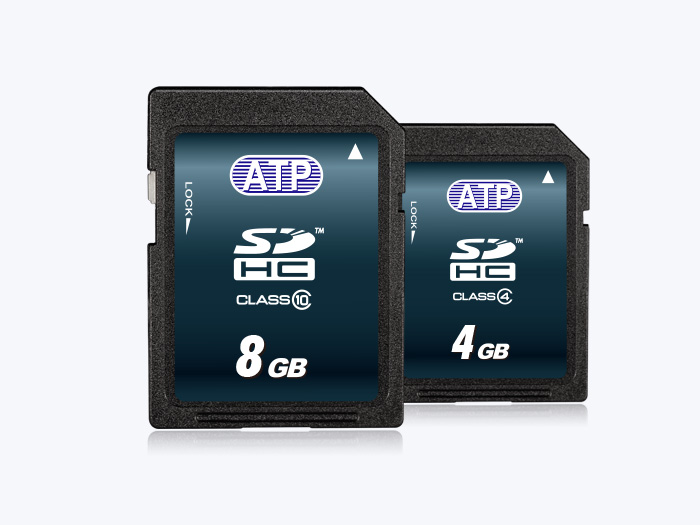
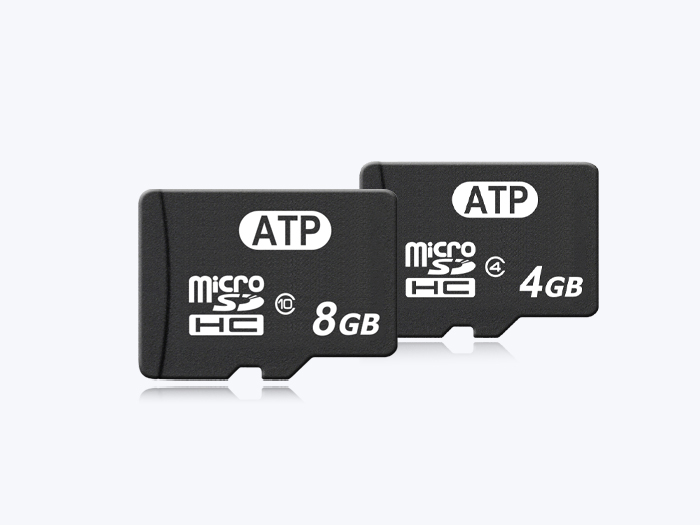
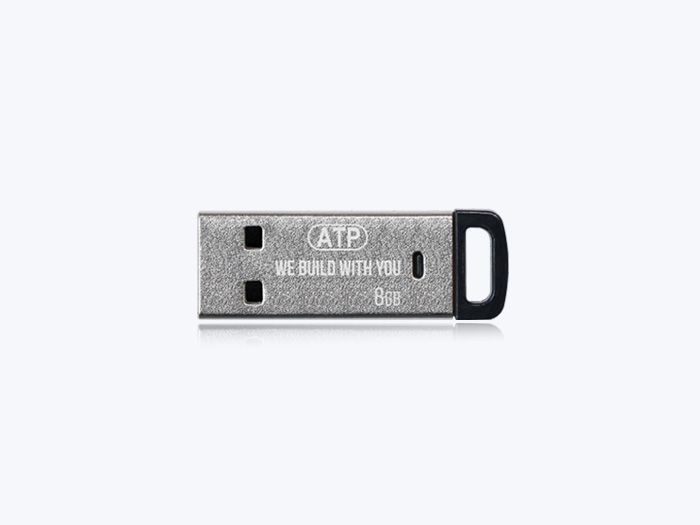
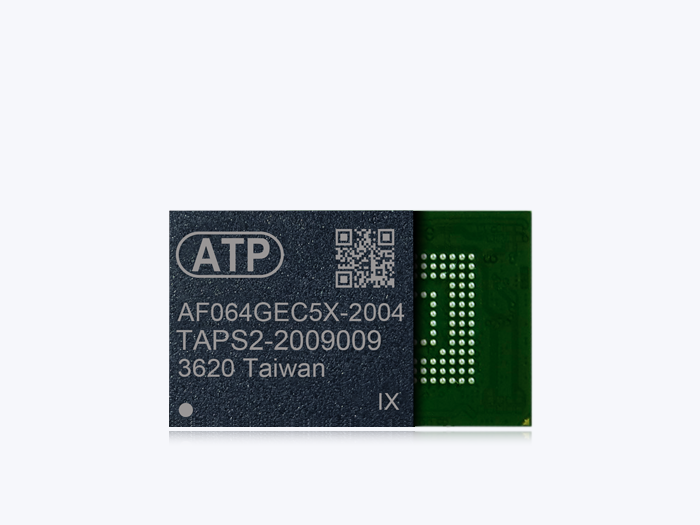
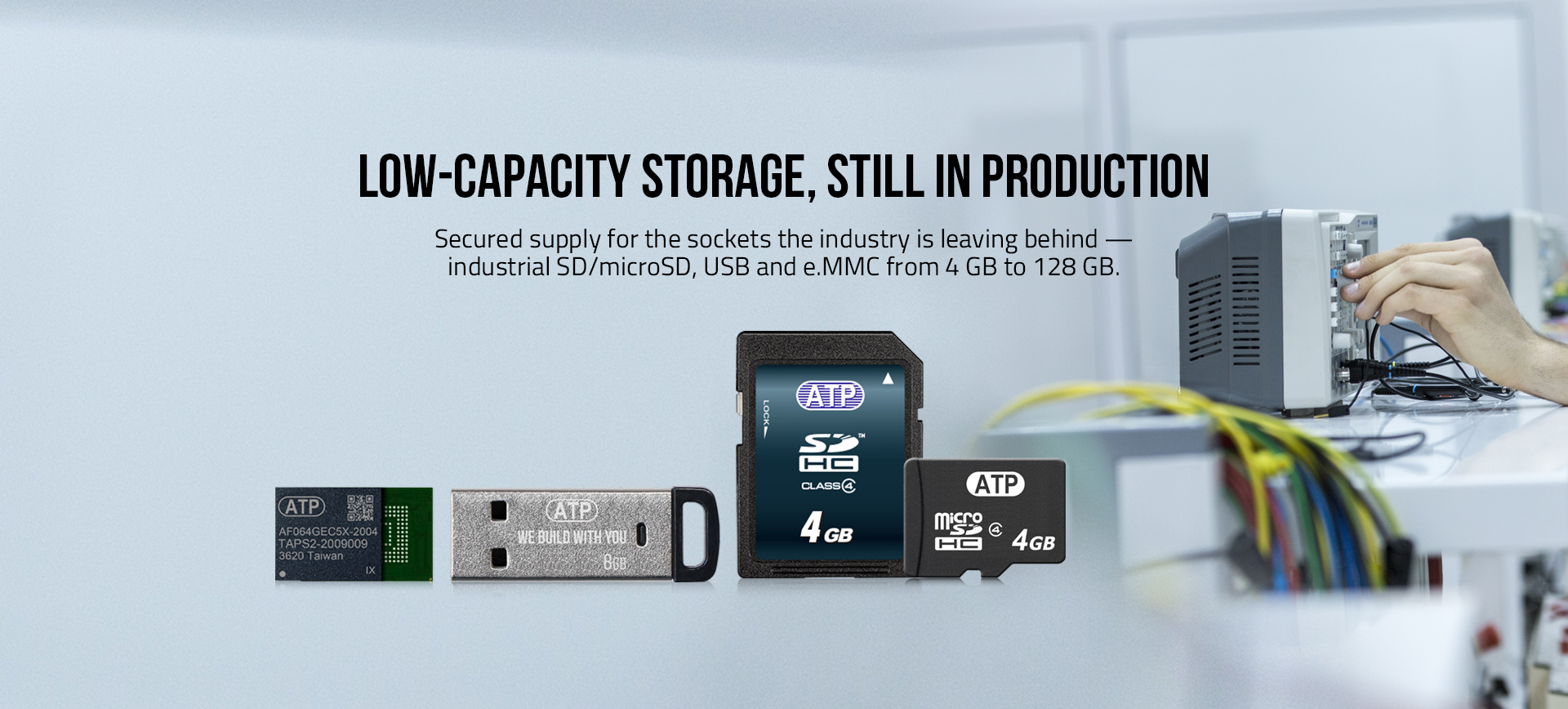
Low-capacity industrial storage is quietly disappearing as NAND makers retire legacy nodes. ATP has secured 2D MLC and 3D TLC supply to keep 4 GB–128 GB SD, microSD, USB 2.0 (NANODURA) and e.MMC in production — so deployed, qualified designs don't have to be redesigned.
Key Takeaways
- Legacy NAND is winding down. NAND manufacturers are retiring legacy 2D MLC and low-density nodes as fab capacity shifts to high-layer, high-capacity products driven by AI demand — and the low-capacity SD cards, USB drives and e.MMC built on those nodes are reaching end-of-life with them.
- An EOL part means requalification. For deployed systems that boot from or log to 4–64 GB of storage, a discontinued part means requalification. In regulated segments such as energy and transportation, revalidating a storage change can cost far more than the components ever did.
- ATP has secured the supply. ATP has secured supply of 2D MLC and 3D TLC NAND to continue manufacturing low-capacity SD/microSD, USB 2.0 (NANODURA) and e.MMC in capacities from 4 GB to 128 GB, in industrial (−40°C to 85°C) and commercial temperature grades.
- pSLC where endurance is the constraint. pSLC options cover the cases where endurance, not capacity, is the constraint — 16 GB SD/microSD configurations for write-intensive logging duty.
- Oversizing is not a neutral fallback. Replacing a 4 GB card with a 256 GB consumer part changes cost, endurance behavior, temperature rating and controller behavior — which usually means requalification anyway.
If your system boots from an 8 GB SD card or logs a few megabytes an hour to a 32 GB e.MMC, the next EOL notice in your inbox may not come from your storage vendor. It comes from the economics two levels upstream: NAND fabs are reallocating capacity to the high-layer, high-density products that AI infrastructure demand pays for, and the legacy nodes behind low-capacity storage are winding down across the industry.
The storage need in the field hasn't changed. A protection relay in a substation, a tachograph in a fleet vehicle, a PLC on a packaging line — these devices were specified around small, dependable, slow-and-steady storage, often in form factors that date back a decade or more. What's changing is whether anyone still builds it.
Why low-capacity NAND is going away
NAND pricing and fab allocation follow density. As manufacturers migrate production to ever-higher layer counts, the older 2D MLC lines and low-density 3D dies that low-capacity products depend on stop earning their place in the fab. The result is a pattern familiar to anyone managing a long-life BOM: minimum purchasable capacities climb year over year, legacy form factors lose their supply base, and parts that were never performance-critical become availability-critical.
This is not a temporary shortage. It is a structural shift in where the industry's capacity goes — which means the response has to be structural too: secured supply of the specific NAND that low-capacity products are built on.
What an EOL notice actually costs in industrial, energy and transportation
The component cost of a 4 GB SD card is trivial. The cost of changing it is not.
A storage part designed into a validated system carries its qualification with it — temperature data, endurance projection, firmware behavior, sometimes a regulatory certification that names the configuration. Swap the part and some or all of that work repeats. For a fleet of deployed RTUs in substations, or onboard recorders across a vehicle fleet, multiply that by every unit in the field plus the engineering time to manage two hardware revisions in service.
That is the real exposure behind the EOL wave: not the price of replacement storage, but the cascade a forced replacement triggers in systems that were supposed to stay stable for years.
The oversizing trap
The common fallback — “just fit the smallest capacity still on the market” — looks harmless on a cost-per-gigabyte basis and rarely survives contact with the qualification process.
A higher-capacity replacement is usually built on a different die, behind a different controller, with different cache behavior, a different temperature rating, and endurance characteristics tuned for a different workload. From the host's perspective it is a new part. You pay more per unit for capacity the application will never write, and you still do the requalification the swap was supposed to avoid.
Right-sizing is the better answer when it's available. The question is availability.
What ATP has secured
ATP has secured supply of 2D MLC NAND and 3D TLC NAND ICs to continue manufacturing low-capacity storage in the form factors legacy designs actually use — aligned to sensible cost per gigabyte at these densities. The offering:
| Form factor | Product line | NAND type | Capacities | Operating temperature |
|---|---|---|---|---|
| SD/microSD | S600Sc | 2D MLC | 4 GB / 8 GB | −25°C to 85°C |
| SD/microSD | S600Si / S600Sc | 3D TLC | 32 GB / 64 GB | −40°C to 85°C / −25°C to 85°C |
| SD/microSD | S700Pi / S700Pc | 3D TLC (pSLC mode) | 16 GB | −40°C to 85°C / −25°C to 85°C |
| USB 2.0 NANODURA | B600Sc | 2D MLC | 4 GB / 8 GB | 0°C to 70°C |
| e.MMC (standard footprint) | E600Si / E600Sc | 3D TLC | 32 GB / 64 GB / 128 GB | −40°C to 85°C / −25°C to 85°C |
Two details worth a designer's attention. The “i” and “c” suffixes denote industrial (−40°C to 85°C) and commercial-grade (−25°C to 85°C, or 0°C to 70°C on NANODURA) temperature ranges — specify against your actual deployment environment, not habit. And the error correction matches the interface generation: BCH ECC on the SD and USB lines, LDPC on the e.MMC lines, where the stronger correction supports TLC behavior over long service.
These products target the segments where low-capacity sockets concentrate: industrial and automation, energy, and transportation — and the applications those segments share: boot storage, small-density low-speed logging, and like-for-like replacement in legacy form factors.
Choosing between MLC, 3D TLC and pSLC at low capacity
For a continuity decision, the choice is narrower than a new design — the goal is matching what the socket was qualified around.
2D MLC (4–8 GB) is the continuity play in its purest form: the same NAND class many legacy designs were originally validated on. If your qualification history is built on MLC behavior and your capacity need hasn't moved, staying on MLC minimizes what changes.
3D TLC (32–128 GB) is the right default where the capacity need has grown past 8 GB or the original part is simply gone. For a device that boots once a day and logs a few megabytes an hour, standard 3D TLC at 32 GB is usually the right call — the endurance math at that duty cycle holds comfortably.
pSLC (16 GB) earns its premium where the write duty is sustained, not occasional — continuous event logging, frequent file-system metadata churn, or any workload where you'd otherwise be projecting TLC endurance with little margin. You give up capacity per die; you get endurance headroom in return. Reserve it for the sockets that need it rather than specifying it everywhere.
If the workload is unclear, the duty cycle is the first thing to measure — projected writes per day against the capacity and endurance of the candidate part settles most of these decisions quickly.
What to do next
The practical first step is a BOM exposure check: which deployed products carry storage under 128 GB, in which form factors, and what does the supply outlook for each part look like? That audit is cheap. The forced redesign it prevents is not.
ATP's design-in team works through exactly these continuity decisions with customers — matching deployed qualification requirements against the secured-supply offering above, including project-based validation where the application demands it. That engagement model is what We Build With You describes.
Conclusion
Low-capacity storage going EOL is an availability problem, not a performance one — and the cost lands in requalification, not components. ATP has secured the 2D MLC and 3D TLC supply to keep the 4 GB–128 GB SD, microSD, USB 2.0 (NANODURA) and e.MMC form factors your designs were qualified on in production. Run the BOM exposure check now, and engage ATP's design-in team early so the continuity path is matched to your deployed qualification rather than forced by the next EOL notice.
Frequently Asked Questions (FAQ)
Q1: Can I still buy 4 GB or 8 GB industrial SD cards?
A: Yes. ATP continues to manufacture 4 GB and 8 GB SD/microSD (S600Sc, 2D MLC, −25°C to 85°C) and USB 2.0 NANODURA drives (B600Sc, 0°C to 70°C) on secured MLC supply, alongside 3D TLC capacities from 32 GB.
Q2: What happens when the NAND inside my qualified storage part goes EOL?
A: The module maker either issues an EOL notice or re-engineers the part on newer NAND — which changes die, controller behavior and often the endurance profile. Either way, your qualified configuration changes, and revalidation is typically required. Securing supply of the original NAND class is the only path that avoids this.
Q3: Is pSLC worth it for a boot drive?
A: Usually not. Boot workloads are read-dominant with infrequent writes, which standard 3D TLC handles with comfortable endurance margin. pSLC earns its cost where writes are sustained — continuous logging or frequent metadata updates. Spend the premium on the sockets that write.
Q4: What's the difference between the industrial and commercial temperature grades?
A: Industrial-grade (“i” suffix) parts operate from −40°C to 85°C; commercial-grade (“c” suffix) parts cover −25°C to 85°C (0°C to 70°C for NANODURA USB). Specify from the deployment environment's actual extremes — an unheated outdoor cabinet is an industrial-grade application even if the system inside is modest.
Q5: How long will ATP continue to supply these capacities?
A: ATP has secured NAND supply specifically to continue serving low-capacity demand and supports long-life deployments through controlled BOMs and longevity programs. For part-specific supply commitments and lifecycle planning, talk to your ATP contact.